
How to Choose an Access Control and Barrier Gate Contractor for a Condominium.
QUESTION ANSWEREDWe need a contractor for our access cards, lift access and car park barriers. How do we choose one, what must we check, and who should own the cards, the data and the passwords?
Choose the contractor before the equipment. Check that its CIDB registration covers the category and the value of the job, ask who will own the card format, the resident database and the administrator passwords, and get one party named for every fault between the barrier and the reader. Then make the choice through a fair and transparent procurement, as the strata by-laws require.
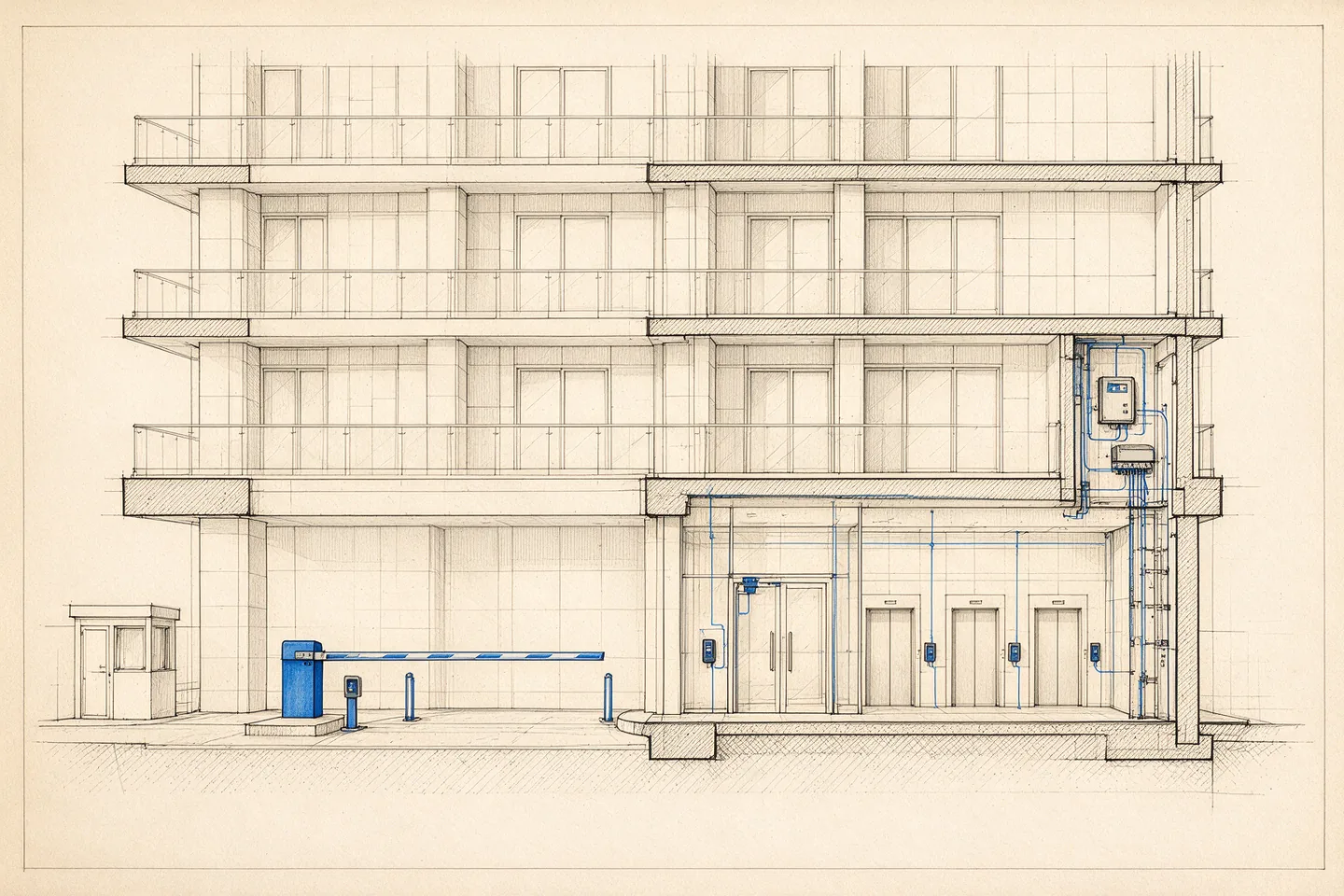
- 01A CIDB grade caps the value of a project: G1 to RM200,000, G2 to RM500,000THE GRADE
- 02Mains work for a barrier belongs with an electrical contractor on the Energy Commission’s registerTHE POWER
- 03The card format, the database and the passwords should belong to the building, in writingTHE OWNERSHIP
- 04Since 1 April 2025 a contractor holding residents’ data must keep it secure itselfTHE DATA
- 05One party answers for the whole lane, or the contract draws the line between themTHE FAULTS
- 01What the contractor looks after§01
- 02The registrations to check§02
- 03A worked example: the grade against the job§03
- 04What a manufacturer’s appointment tells you§04
- 05Who owns the cards, the data and the passwords§05
- 06Who answers when the barrier will not read a card§06
- 07Running the selection§07
- 08What to ask every bidder: a checklist§08
- 09The mistakes committees make§09
- 10When the usual advice does not apply§10
- QQuestions committees askF-A
ON THIS SHEET11 SECTIONS
What does an access control and barrier gate contractor actually look after?
Everything that decides who gets in: the readers, the controllers, the locks, the lift interface, the software that holds the resident list, and the barrier arm in the car park lane. In a condominium these are one system, which is why our guide ELV systems in Malaysian buildings: every layer, one contractor treats access control as one layer of the building’s ELV systems.
Our own description of the work, from our company profile, shows how wide it runs: “Card and fob systems, readers and controllers, lift access integration, door hardware, and management of resident and visitor credentials across multiple entry points.” The barrier adds a mechanical job on top: “Vehicle barriers, boom gates, turnstiles and bollards for entry lanes and pedestrian gates, including the mechanical servicing that keeps them running.”
That width is why the choice of contractor matters more than the choice of reader. Readers can be replaced; the database of every resident’s card, the lift programming and the way the barrier takes its orders from the reader stay with the building for years, and someone has to understand them.
Two kinds of power meet in this work. The readers and controllers are Extra Low Voltage, which under the Electricity Regulations 1994 means systems that run at no more than 50 volts AC or 120 volts DC. A barrier’s drive and control box are normally connected to the building’s mains supply, which is ordinary electrical work rather than ELV wiring. A contractor for the whole lane has to be able to do both, or say who will.
The duty to keep all of it working sits with the management. The strata by-laws require the management corporation to “maintain in a state of good and serviceable repair, and, where necessary, renew or upgrade, the fixtures and fittings, lifts, installations, equipment, devices and appliances existing in the development area”.
The contractor is how a committee meets that duty, which is why it deserves the same scrutiny as the equipment. Our service pages for access card and lift access control and barrier gates and car park entry describe the systems themselves.
Which registrations should the contractor hold?
Three, depending on the job: a CIDB registration whose grade and category fit the work, an electrical contractor on the Energy Commission’s register for any mains connection, and readers that keep within MCMC’s radio rules if the car park uses long-range tags. Each can be checked before a quotation is even opened.
CIDB comes first. Every contractor must register with CIDB under section 25 of Act 520 before undertaking construction work in Malaysia, and the Act’s definition of construction works covers “installation, repair, maintenance” of, among other things, “any electrical, mechanical, water, gas, petrochemical or telecommunication works”. A contractor convicted of working unregistered can be fined RM10,000 to RM100,000 under section 29.
Registration is not one yes-or-no. CIDB registers each contractor by grade, category and specialisation, and the four categories are civil engineering (CE), building (B), mechanical and electrical (ME) and facilities (F). The grade sets the largest project the contractor may take, and CIDB says plainly that a contractor “cannot carry out any construction project outside his registration category”.
Checking takes a minute. CIDB certificates are printed online and “each certificate will be placed with a QR Code”, so scan it with a phone rather than accept a photocopy, and read the grade and category on the record that comes up.
The Energy Commission covers the mains side. Suruhanjaya Tenaga registers electrical contractors by category under the Electricity Regulations 1994 and publishes the list of registered electrical contractors on its website. If the barrier, the gate motor or a new power point for a controller needs a mains connection, ask which registered electrical contractor will do it and check the name against that list.
MCMC covers the radio. Long-range car park readers work on UHF, and MCMC’s plan for them, SRSP-530, says readers “shall operate only within the band 919 MHz to 923” MHz. A reader below 2 W of radiated power is covered by a class assignment, which needs no application and no fee; up to 4 W needs an apparatus assignment; above 4 W is not permitted. Ask the bidder to state the reader’s power in writing.
| Register | Who keeps it | What to ask for | Why it matters |
|---|---|---|---|
| Contractor registration (PPK) | CIDB, under Act 520 | The certificate, scanned by its QR code: grade, category, expiry | The grade caps the project value; working outside the category is barred |
| Electrical contractor | Energy Commission, under the Electricity Regulations 1994 | The name of the registered electrical contractor for any mains work | The barrier and its control box run on mains power, which ELV wiring is not |
| Radio spectrum | MCMC, SRSP-530 | The reader’s band and radiated power, in writing | Below 2 W needs no application; up to 4 W needs an assignment; above 4 W is not permitted |
None of these proves a contractor is good. They prove it is allowed to do the work, which is the floor below which no comparison of prices should start.
A worked example: does the bidder’s grade cover the job?
Read the grade against the full value of the work, including what the committee may add later. CIDB’s grades set the most a contractor may take on one project: G1 up to RM200,000, G2 up to RM500,000, G3 up to RM1 million, G4 up to RM3 million, G5 up to RM5 million, G6 up to RM10 million, and G7 with no limit.
Take a condominium replacing the card readers at its lobbies and the barriers at its car park entrance, priced at RM440,000. It is an illustration, not a quotation from any building. Three bidders reply.
| Bidder | Grade limit | The job at RM440,000 | If lift access is added: RM560,000 |
|---|---|---|---|
| Bidder A, G1 | RM200,000 | Above its limit: cannot take the project | Cannot take it |
| Bidder B, G2 | RM500,000 | Within its limit | Above its limit: the job has outgrown the bidder |
| Bidder C, G3 | RM1 million | Within its limit | Within its limit |
The second column is where committees get caught. Half-way through the selection someone proposes adding floor-restricted lift access for RM120,000, and the project becomes RM560,000. Bidder B, the cheapest on the first scope, can no longer take it on its own registration. The fair way out is to re-price the whole scope with every bidder, not to award the first part to Bidder B and the lift work to someone else.
The larger figure also changes the paperwork. CIDB charges a levy of 0.125% on construction contracts worth more than RM500,000, and “The levy shall be settled/paid by the main contractor who had made the declaration for the entire value of the project.” On RM560,000 that is RM700. It is small, but CIDB puts it on the main contractor, so a quotation that passes it to the building as a separate line deserves a question.
What this example does not show is quality. A G3 bidder is allowed to take the job; whether it does the job well is what the rest of this guide is for. How to make three different proposals comparable line by line is set out in comparing security system quotations.
What does a manufacturer’s appointment tell you?
That the contractor can go back to the factory. An appointment by the maker of the equipment on your site is the difference between a fault that is escalated and one that is guessed at, and it is worth more than a long list of logos.
We put the reason this way in our company profile: vendor accreditation matters because “it determines whether we can escalate a fault to the factory, source genuine spares quickly, and access the firmware and technical support that turn a dead system into a working one”. A contractor without that route can still fix a loose cable. It cannot get a controller’s firmware or a spare board that is no longer sold through ordinary dealers.
Read the appointment carefully. Ask for the maker’s letter, its date and whether it is still current, and match it to the brand actually installed in your building. Our own MicroEngine appointment reads as the maker gave it: MicroEngine appointed us an Authorised System Installer in 2014, and the appointment is current.
A brand list on a contractor’s website, ours included, is a different thing: we list the access control brands we supply, service and support (ZKTeco, Soyal, HID, EntryPass, Vanderbilt, Rosslare, deister) and the barrier brands (Magnetic, Nice, dormakaba, ZKTeco), and none of that is a claim of appointment by them.
Barriers add a rule of their own. One barrier maker’s operating instructions say: “A written authorisation of the manufacturer is required before executing any technical changes and extensions on the barrier.” The same maker’s service experts are electricians “trained and authorised by MAGNETIC to perform special repair and service work” on its barriers.
A contractor who proposes adding a sensor or a reader to the barrier housing should show that authorisation, or explain why it is not needed.
The exception is the building with several brands already, which is most of them. “Strata buildings inherit whatever the developer or the last contractor installed, so working across brands is what lets us repair rather than replace.” There, ask which of the installed brands the contractor can escalate, not which brands it sells.
Who should own the card format, the database and the passwords?
The building, and the contract should say so. If the contractor alone can order cards, export the resident list or log in as administrator, the building cannot change contractor without starting again, and every committee after this one inherits that dependence.
The card format. Cards carry a number in a format the readers understand, and some formats are registered to one owner. One card maker’s programme gives an end-user “a 35-bit card format that is developed specifically for each individual end-user customer”, and under it “the end-user may order cards from multiple sources (as designated by the end-user) and be guaranteed that card number duplication will not occur”.
The question for a condominium is who the end-user is on paper. If it is the building, the building can buy cards from anyone it designates. If it is the contractor, every replacement card goes through that contractor.
The database and the passwords. Ask for the administrator login to be issued to the management, for the software licence to be in the building’s name, and for an export of the card database to be handed over on request and at the end of the contract.
Our own way of working, as our About page sets it out, begins with a preliminary site recce: “Equipment identified by brand and quantity, the access-card system backed up, drawings and as-built records audited, and a summary report.” A building whose database has never been backed up should treat that as urgent, whoever it hires.
The residents’ personal data. The card database holds names, unit numbers and movements, and a face reader holds more. Under the Personal Data Protection (Amendment) Act 2024, biometric data now means “any personal data resulting from technical processing relating to the physical, physiological or behavioural characteristics of a person” and is listed as sensitive personal data.
The same Act says that where a data processor processes personal data for the data controller, “the data processor shall comply with the Security Principle as specified in section 9.”
Those provisions came into operation on 1 April 2025. In practice, a contractor that hosts, administers or backs up the resident database for the management is processing it on the management’s behalf and carries its own duty to keep it secure. Ask how the database is protected, who on the contractor’s side can see it, and what happens to the contractor’s copies when the contract ends.
The same questions decide how painful a handover is later. What goes wrong when nobody can find the passwords at a change of management is in JMB to MC handover; how a database fault looks to a resident is in access card not working. We put the principle in one line in our company profile: “Multi-brand by design, so the building is never held hostage.”
Who answers when the barrier will not read a card?
One named party, written into the contract. A resident stuck at the barrier does not care whether the fault is in the card, the reader, the controller, the database or the barrier’s own control box, and a building that has split those between contractors usually hears each of them blame the other.
The lane is a chain. The card is read by the reader, the reader reports to a controller, the controller checks the database and tells the barrier to open, and the barrier’s own safety loops and light beam, explained in our barrier guide, decide when the arm may close.
A card contractor and a barrier contractor meet in the middle of that chain, at the connection between the controller and the barrier, and that is where the arguments start.
We describe what a building should have instead as “a single accountable party for the management office instead of four separate vendors pointing at each other.” Our earlier piece one contractor or five? sets out what goes wrong when a building’s systems are split, and the barrier lane is its clearest case.
If the building does keep two contractors, for example because the barrier is under a separate warranty, draw the boundary in both contracts: which terminal is the hand-over point, who tests the lane end to end after any change, and who attends first when a resident is stuck.
The barrier also needs its own routine: one maker’s instructions say “Test the barrier system monthly.” The safety devices and maintenance a barrier needs are in our barrier gate guide; choosing between cards, tags and number plates at the gate is in condominium car park entry, and restricting lifts by floor is in lift access control.
How should the committee run the selection?
As a written, fair and transparent procurement, because the by-laws require it. The Third Schedule to the Strata Management (Maintenance and Management) Regulations 2015 obliges the management corporation to “set up, manage and maintain proper procurement procedures and tender process in a fair and transparent manner for all purchases, acquisitions or awards of contracts in connection with the management and maintenance of the common property” (by-law 3(7)). The by-laws read the term management corporation to include a JMB.
The regulations do not say how to do it, so the order below is a practical one. It keeps every bidder pricing the same job and leaves a record the committee can show owners at the AGM.
- Write down what exists. List every reader, controller, barrier and lift interface, with brand and location, and find out who holds the administrator login today.
- Write the scope of works. Name each entry point and what must happen there, including the lift floors and the barrier lane, so no bidder can price a smaller job.
- Set the conditions before the prices. Registrations, ownership of the card format, database and passwords, the fault boundary and the data duties, all from this guide, in the invitation itself.
- Invite bidders to see the site. A contractor who prices access control without walking the lanes, lobbies and riser is pricing a guess.
- Check the registers before reading prices. Scan each CIDB certificate and read the grade against the full value, as in the worked example.
- Compare like with like. Put every proposal on the same rows, then compare totals, as in comparing quotations.
- Decide in a minuted meeting. Record why the winner was chosen, not only that it was cheapest.
- Sign a maintenance agreement with the installation. What it must oblige the contractor to do is in what a maintenance agreement must oblige.
A good bidder will want to look before it prices. We hold ourselves to the same line: “We diagnose before we quote, and we repair rather than replace wherever the equipment still has life in it.” A bidder that proposes replacing the whole system before it has seen it is telling you something about how it will work for you.
What should we ask every bidder?
The same twelve questions, in writing, with the answers kept on file. Print this table and attach it to the invitation; the right-hand column is what to watch for in the replies.
| Ask for | Why | Watch for |
|---|---|---|
| The CIDB certificate | Grade and category must fit the full job | A photocopy you cannot scan, or a grade below the value |
| The registered electrical contractor | The barrier and controllers need mains power | A promise that their own technician will connect it, with no registered name |
| The maker’s appointment letter | Factory escalation, spares and firmware | A logo wall with no letter, or a brand you do not have |
| Written authorisation for barrier changes | The maker requires it for any modification | Sensors added to a housing with no approval |
| Who the card format is registered to | The owner decides who can sell you cards | Cards only obtainable from the bidder |
| The software licence holder | The building keeps the system if the contractor leaves | A licence in the contractor’s name |
| Administrator logins for the management | Cards can be issued and cancelled without waiting | Only the contractor can add or delete a card |
| A database export, on request and at the end | The next contractor can start from the records | A refusal, or a fee to release the building’s own data |
| How the contractor protects residents’ data | A processor must meet the Security Principle | No answer on who can see the database |
| The reader’s band and power | MCMC’s 919 to 923 MHz band and 4 W ceiling | A long-range reader with no stated power |
| The fault boundary at the barrier | One party attends a stuck lane | Two contracts that each exclude the interface |
| As-built drawings at handover | The next fault is found from the records | Drawings promised on request but never delivered |
A bidder that answers all twelve plainly has already shown the thing the committee most needs to know: that it expects to be held to what it says.
What mistakes do committees make when choosing one?
Most come from treating access control as a purchase instead of a service. We put it bluntly in our company profile: “Security in that environment is not a product you install and walk away from. It is a service you have to keep showing up for.” The usual mistakes follow from forgetting that.
- Comparing totals first. Three totals for three different scopes say nothing until the proposals are on the same rows.
- Checking that a CIDB registration exists, not what it covers. The grade and category are the point, and the value can grow during the selection.
- Leaving ownership unwritten. If the contract is silent on the card format, the licence, the logins and the database, the contractor holds them by default.
- Splitting the lane without a boundary. A card contractor and a barrier contractor with no agreed hand-over point will each send a resident to the other.
- Letting changes go undocumented. A reader added to a barrier without the maker’s written authorisation, or a wire moved without updating the drawings, becomes the next contractor’s mystery.
- Choosing for the AGM, not for the next committee. “In a sector where committees change, budgets tighten and contractors are replaced routinely”, a contract that only today’s committee understands is a weak one.
When does the usual advice not apply?
When the job is small, inherited or partly someone else’s. The checks above still hold in spirit, but their weight shifts.
- A maintenance-only contract for an existing system. The installed brand decides more than the bidder’s catalogue: ask who can escalate that brand to its maker, and whether the bidder can work with the database as it stands. Occhio Tec takes over and maintains systems another contractor installed; the questions to ask any contractor about that are in taking over another contractor’s system.
- Card-only car parks. A barrier opened by the same short-range card as the lobby has no radio question, so the MCMC row of the checklist falls away. A long-range tag reader below 2 W needs no application and no fee, which is why the power must be stated.
- A building with no face readers. The biometric rules bite only where biometric data is processed; a card-only system still holds personal data and still needs the processor questions.
- Defaulter cards. Switching off a card for unpaid charges is a by-law matter, not a feature to buy: by-law 6(4) caps the reactivation charge at RM50, and the software only has to do what the by-law allows.
- A developer still in charge. During the developer’s management period the by-laws read the developer as the management corporation, so the procurement duty is the developer’s. A committee taking over later should still ask for the logins, the licence and the database.
How does Occhio Tec work on access control and barrier gates?
Occhio Tec, established 2012, designs, installs and maintains multiple systems for condominiums: barrier, door and lift access, CCTV, intercom, networking and fibre. MicroEngine appointed us an Authorised System Installer in 2014, and the appointment is current. Letters from building managers on our work page name CCTV surveillance, barrier gate operations and access control among the systems we look after.
We also take over and maintain systems another contractor installed. We work in Mont Kiara, Bangsar, KLCC, Desa Park City, Bukit Jalil, PJ, Cyberjaya and Putrajaya and Klang, and the reach is still growing. If your committee is about to choose an access control or barrier gate contractor, or wants to know what its present one has left it holding, request a site survey.
Questions committees ask about access control contractors
Q-01Does an access control contractor need CIDB registration?
For installation and maintenance work, yes. Act 520 counts the installation, repair and maintenance of electrical and telecommunication works as construction works, and every contractor must register with CIDB before undertaking them. The grade caps the project value, from RM200,000 for G1, and a contractor may not work outside its registration category. Scan the certificate’s QR code to check it.
Q-02Should the building or the contractor own the access card database?
The building. Ask for the software licence in the building’s name, administrator logins for the management and a database export on request and at the end of the contract. A contractor that holds the resident database for the management is a data processor, and since 1 April 2025 it must comply with the Security Principle itself.
Q-03Can we change contractor if our cards only work with the old contractor’s system?
Usually, but find out who the card format is registered to first. Where a format is registered to the end-user, that owner may order cards from any source it designates. If the format, the licence or the logins sit with the old contractor, negotiate their release before you award the new contract, or budget for new cards.
Q-04Do we need separate contractors for the barrier gate and the access cards?
No, and one is simpler. The card, the reader, the controller and the barrier form one chain, and split contractors meet at the cable between controller and barrier, where faults are hardest to place. If you keep two, both contracts must name the hand-over point and who attends first when a resident is stuck at the lane.
Q-05Does face recognition change what we ask the contractor?
Yes. Since the 2024 amendment, biometric data, including data from technical processing of a person’s physical characteristics, is sensitive personal data. Ask where the face templates are stored, who on the contractor’s side can see them and how they are deleted when a resident leaves. A contractor processing them for the management must meet the Security Principle.
Q-06Can the access system switch off a defaulter’s card?
The by-laws allow it, so the software should be able to. By-law 6(4) of the Third Schedule lets the management deactivate a defaulter’s card, tag or transponder once the notice period has expired, and caps the reactivation charge at RM50. Make sure the management, not only the contractor, can switch cards off and on.