
Barrier Gate Systems in Malaysia: A Complete Boom Gate Guide.
QUESTION ANSWEREDWe are replacing or specifying a car park barrier. What types are there, how do cars get through, what safety, power, fire and maintenance rules apply, and what decides the cost?
A barrier gate, also called a boom gate or parking barrier, is a motor-driven arm that opens a vehicle lane when a card, tag, number-plate camera or guard tells it to, and must never close on anything beneath it. Choosing one in Malaysia means matching the arm to the lane and the headroom, giving people on foot their own opening, setting a closing speed the maker approves for that lane, and deciding the safety loops, power-failure and fire behaviour before the committee approves the purchase.
- 01On Magnetic's datasheets, a barrier for a lane up to 3.5 m opens or closes in 1.3 to 2.2 seconds at its fastest setting; arms for 5 to 6 m lanes start at 4.0 seconds and a 10 m arm at 8 seconds. The datasheet headline is a single number, but several models set opening and closing separately.
- 02A barrier is for vehicles: people on foot need a separate opening. Where the movement of persons still cannot be ruled out, Magnetic approves its fast Access Pro only at a 2.5-second closing, so a busy residential entrance needs both.
- 03For cars, the safety loop must reach at least 500 mm in front of and behind the arm, and the opening loop must sit no more than 1.0 m from it (Magnetic's operating instructions, US edition).
- 04Battery backup is an option, not a standard part, on Magnetic's barriers: decide the power-failure behaviour before buying, and wire the fire signal to the barrier's high-priority open input.
- 05In a strata building the committee approves the purchase unless a general meeting has restricted it, the procurement must be "fair and transparent", and a replacement is paid from the sinking fund (at least 10% of the Charges).
- 06Under the 2015 strata by-laws, a defaulter's tag may be switched off 14 days after notice, with reactivation capped at RM50.
- 01What a barrier gate is and how it works§01
- 02The types, and which suits which lane§02
- 03How fast it should open and close§03
- 04How residents and visitors get through§04
- 05The safety devices it must have, and people on foot§05
- 06Power failures, fires and lightning§06
- 07The maintenance it needs§07
- 08Why it stops working§08
- 09How long it lasts§09
- 10What decides the cost, and what a quotation should list§10
- 11How a JMB or MC approves the purchase, and which fund pays§11
- 12Owners in arrears: a worked example in RM§12
- 13Who pays when it damages a car§13
- 14Boom gates in landed guarded neighbourhoods§14
- 15The mistakes buildings make§15
- 16When the usual advice does not apply§16
- 17Planning a new or replacement barrier: a checklist§17
- 18How we work on barrier gates§18
- 19Questions committees askF-A
ON THIS SHEET18 SECTIONS
What is a barrier gate and how does it work?
A barrier gate, or boom gate, is a housing beside a vehicle lane with a motor-driven arm that lifts for one vehicle and lowers behind it. In a Malaysian condominium or office car park the barrier gate system is the vehicle half of access control: a reader decides who may pass, and the barrier makes sure only they do.
The machine is simpler than its price suggests. Magnetic Autocontrol, the German maker of one of the barrier brands we supply, service and support, puts it in one sentence in its operating instructions: "The barrier consists of the barrier housing with drive system and control, as well as the barrier arm." Balancing springs in the housing carry the arm's weight, so the motor moves a balanced load. That is why the spring setting appears both in the yearly service and in the fault list further down this guide.
A barrier takes its orders from one of two places. In manual mode a guard presses the button; in automatic mode an access control system sends the open signal. Either way, induction loops cut into the road and safety light barriers across the lane watch the space under the arm. Our guide to condominium car park entry sums up the barrier's job, whatever reader sits in front of it: "clear the queue, refuse to close on a car, and open on an emergency signal".
Barrier drives are built for continuous work. Magnetic's datasheets give a 100% duty cycle for its Access and Parking Pro barriers, which means they may run continuously rather than resting between cycles, and a maximum power draw of 25 W for the standard Access model and 95 W for the fast Access Pro and Parking Pro. A barrier gate is one layer of a building's systems, working beside the CCTV over the lane and the guardhouse intercom, which is why our guide Every layer, one contractor treats them together. This guide explains how barriers work and the rules around them; our supply, installation and maintenance service is described on barrier gate and car park entry systems for Kuala Lumpur buildings.
What types of barrier gate are there, and which suits which lane?
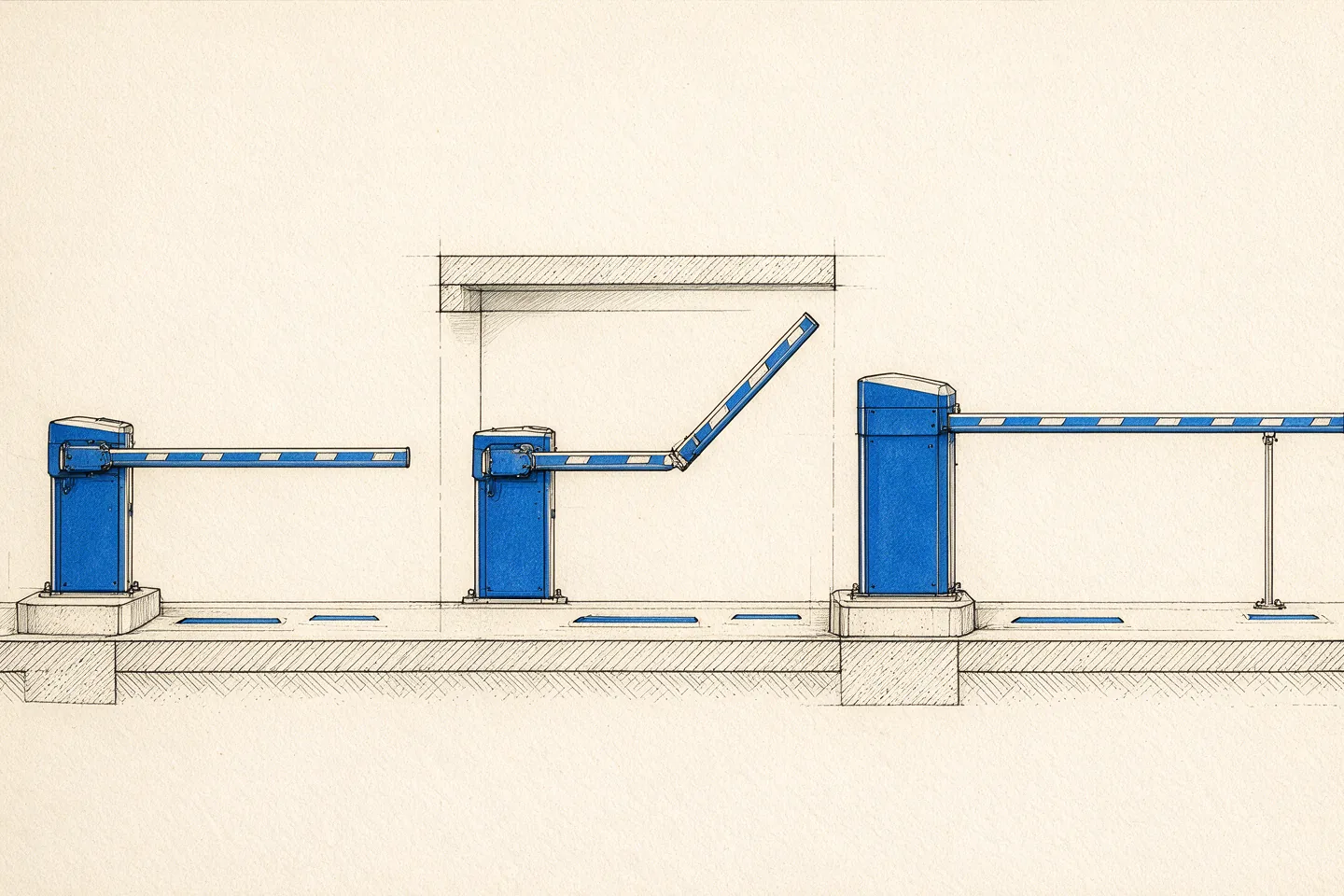
Barrier gates differ by the lane they close: its width, the headroom above it and who uses it. One maker's range shows the spread. Magnetic's standard straight arms cover lanes up to 3.5 m, its long arms 5 to 6 m and its widest model 10 m, while an articulated (folding) arm handles lanes up to 4.5 m under a low ceiling. Choose the arm first, because the lane fixes it.
| Type (Magnetic model) | Lane width | Opening and closing times | Where it fits | Watch for |
|---|---|---|---|---|
| Standard straight arm (Access) | Up to 3.5 m | Opening fixed at 2.2 s; closing set to 2.2, 2.8 or 3.5 s | Guardhouse lanes, residential entrances | Approved where the movement of persons cannot be ruled out, once the legally required safety equipment is fitted |
| Fast straight arm (Access Pro) | Up to 3.5 m | 1.3, 1.8 or 2.5 s, set separately for opening and closing | Busy residential and office entrances | Approved where the movement of persons cannot be ruled out only at the 2.5 s closing |
| Car park barrier (Parking Pro) | Up to 3.5 m | 1.3 s on the datasheet; 1.3, 1.8 or 2.5 s for opening and for closing in Magnetic's tender text | Heavily used multi-storey and basement car parks | Built for facilities where the movement of persons can be ruled out; detects tailgating vehicles with induction loops |
| Long straight arm (Access-L, Access Pro-L) | Up to 5.0 m and 6.0 m | 4.0 s (Access Pro-L: 4, 6 or 8 s, set separately) | Wide gates, two-way entrances | A pendulum support or support post is required from a boom length of 3.5 m |
| Arm with a skirt (Access Pro-H) | Up to 6.0 m | From 4.0 s | Entrances that must also stop people climbing over | Optional boom skirt with climb-over prevention up to 1.8 m high |
| Extra-wide arm (Access XXL) | Up to 10 m | 8, 10 or 12 s, set separately | Loading yards, wide service entrances | Approved where the movement of persons cannot be ruled out only at the slow or medium closing up to 7 m, and at all three from 7 m |
| Articulated (folding) arm | Up to 4.5 m | As the barrier it is fitted to | Basement entrances under a low slab | Fits the Access, Access Pro and Parking Pro barriers, among others |
Arm lighting is the cheapest of the options to justify: on Magnetic's VarioBoom the LEDs are red while the arm is closed and green when it is open, which makes the arm visible on a dark basement ramp.
What happens to the arm when a car hits it?
That depends on how the arm is mounted, and Magnetic's manual treats three mountings differently. An arm on a SwingAway mounting swings out of the way: with automatic return it comes back after a delay, and with manual return someone puts it back by hand. An arm on the breakaway flange (Magnetic's FLVB02, an option on the Parking Pro) is pushed out of its clamp when a driver forces through and "can be re-attached again without any impairment of function". For a barrier with neither, the manual's instruction is short: "Replace the barrier arm."
SwingAway and the breakaway flange are separate features, with separate entries in the manual's fault table. Magnetic's tender text adds a limit worth knowing before ordering: the breakaway flange is "not possible in combination with articulated boom, boom illumination or locking mechanism", so a basement lane that needs a folding arm cannot also have it.
Does the brand matter?
Less than the figures do. We use Magnetic as the reference here because its datasheets are public and detailed. It is one of four barrier brands we supply, service and support, with Nice, dormakaba and ZKTeco. As our About page puts it, "Strata buildings inherit whatever the developer or the last contractor installed, so working across brands is what lets us repair rather than replace." Whatever the brand, ask every bidder for the same three figures from the datasheet of the model it offers: the maximum lane width, the opening and closing times at each setting, and the duty cycle.
How fast should a barrier gate open and close?
Fast enough for the traffic, and no faster than the people near the lane allow. Magnetic's datasheets print one headline figure for opening and closing, and it is the fastest setting: 1.3 seconds on its fast 3.5 m barriers and 2.2 seconds on the standard one, while arms of 5 to 6 m start at 4.0 seconds and a 10 m arm at 8 seconds. Several models set opening and closing separately, so closing can be set slower than opening.
The settings matter more than the headline. The standard Access opens in a fixed 2.2 seconds and closes in 2.2, 2.8 or 3.5 seconds; the Access Pro sets opening and closing separately at 1.3, 1.8 or 2.5 seconds; the long Access Pro-L at 4, 6 or 8 seconds. Longer arms are slower by design, so the lane width decides the speed range before any brochure does. Ask each bidder to write down the closing time it will actually set, not the datasheet headline.
Closing time is also a safety setting. Where "the movement of persons cannot be ruled out", Magnetic approves its Access Pro only "at a reduced closing speed of 2.5 seconds", and that slower closing comes on top of a separate opening for people on foot, never instead of one. The full rule is under people on foot.
How much time does the arm cost in a morning rush?
Less than most committees expect. As an illustration, take 30 cars arriving one after another in the morning. Each car costs one opening and one closing, so at the fastest setting a 1.3-second arm spends 30 × 2.6 = 78 seconds moving, a 2.2-second arm 132 seconds, and a 6 m arm at 4.0 seconds 240 seconds. Setting the fast arm to open in 1.3 seconds but close in 2.5 adds 30 × 1.2 = 36 seconds across the 30 cars, about 1.2 seconds a car.
The driver often costs more than the arm. A car that stops, lowers its window and presents a card moves at the driver's pace, which is why busy entrances look at long-range tags or number-plate cameras. Congested entry lanes are one of the problems we see at strata car park entrances, beside unauthorised parking and "visitor movements that nobody can reconstruct after the fact".
Does closing speed matter for security?
Yes, because a slow arm lets a second car through. In the Sunway Parking case, a paid commercial car park rather than a condominium, closed-circuit television records showed a car thief who "tailgated" another vehicle out "as the barrier gate was too slow in coming down to prevent the stolen vehicle from escaping". What the court then decided is under who pays.
Car park barriers answer tailgating with detection rather than raw speed. Magnetic's Parking Pro detects "tailgating by following vehicles by means of induction loops", and its tender text lists a configurable "reaction to unauthorised vehicles following (tailgating)". Put both the closing time and the tailgating reaction into the specification, not the small print.
How do residents and visitors get through the barrier?
Through whatever sends the barrier its open signal: a card at a reader, a long-range tag, a number-plate camera, or a guard's button for visitors. A building can run more than one at the same entrance, such as tags for residents and the guard's button for visitors. Our guide to tag, card or number plate compares the resident methods in depth; this section is the overview a committee needs before it reads the quotations.
| Method | How it works | What to check |
|---|---|---|
| Access card at a reader | The driver stops and presents the building's card at a reader on a post | Whether the same card also runs the lobby and lift readers |
| Long-range tag or card (UHF) | A reader picks the tag up from a distance, so the driver need not stop | The reader must work in the 919 to 923 MHz band of MCMC's 2005 RFID plan (SRSP-530), inside its power class |
| Number-plate recognition (ANPR or LPR) | A camera reads the plate and checks it against the building's list | Which plate types the software supports, and the camera's mounting angles and height |
| Guard's button or intercom | A person opens the barrier in manual mode, usually for visitors | What the guardhouse records about each visitor, and on what basis |
A number-plate barrier works only inside its conditions. A white paper from Bosch, one of the CCTV brands we supply, service and support, warns that some ANPR software cannot handle every plate background colour and that "many ANPR suppliers can handle only retroflective license plates"; that the minimum pixels across a plate "can differ per country"; and that the camera should sit higher than the plate to reduce headlight glare, inside the mounting angles the software supplier sets. Ask for any accuracy figure in writing, measured on your lane with your residents' own plates.
We fit licence plate recognition at vehicle barriers for three jobs our company profile names: "automatic vehicle entry for registered residents, visitor lane management, and a searchable record of vehicle movements for incident investigation". The third is the one committees forget to specify. A plate log that can be searched by number and time after an incident, kept beside the CCTV footage of the same lane, answers the question a committee is asked after a car park theft or scrape: which car came through, and when.
Long-range readers are radio transmitters, so they come under MCMC. Its Standard Radio System Plan for RFID, SRSP-530, issued on 31 October 2005 and still the reference for this band in MCMC's registered 2020 technical code for short range devices, sets the band at 919 to 923 MHz: a reader below 2 W ERP is covered by a class assignment, which needs no application and no fees, up to 4 W needs an apparatus assignment, and above 4 W is not permitted. Visitors still need a person or a process: what the guardhouse may write down is in can a guardhouse keep your IC, and how a visitor app fits in is in condominium visitor management. The readers and cards themselves are on our access card and lift access control page.
What safety devices must a barrier gate have?
Devices that stop the arm closing on anything below it, and a separate way through for people. Magnetic's operating instructions state the duty plainly: "The surveillance device must prevent the closing of the barrier in case a person or a vehicle is standing below the barrier." Two kinds of device do that job, induction loops cut into the road and safety light barriers (photocells) across the lane. The "must" in this section is the maker's: these are Magnetic's conditions of use, and the last part of the section says what we could and could not find in Malaysian rules.
Where must the loops and light barriers go?
| Device or rule | What the manual requires |
|---|---|
| Safety loop | Secures the danger area under the arm "throughout the entire length"; for passenger cars it reaches at least 500 mm in front of and behind the arm, and for trucks it is at least 2.5 m long in the direction of travel |
| Opening loop | Sits right in front of the safety loop, no more than 1.0 m from it |
| Loop position | About 300 to 500 mm from the roadside, and at least 50 mm from iron reinforcement in the road |
| Loop feed line | No longer than 15 m, never coiled, twisted up to the detector terminals |
| Safety light barrier | Commissioning test: an object held in the beam makes the receiver's yellow LED go out, and the barrier cannot close |
| Clearance | At least 610 mm (the US edition's "2 ft") between the arm and walls or other objects |
The US edition gives each figure in feet and inches with millimetres beside it, and uses US electrical terms. The edition supplied with a barrier in Malaysia may differ in places, so check these figures against the manual that comes with your barrier.
Loops have a blind spot: they respond only to metal. The manual says vehicles "need to have sufficiently large metal areas in the vehicle floor area to enable detection by induction loops", and that "other or complementary safety facilities must be provided" for vehicles that cannot be detected that way. Ask the supplier which vehicles its loops will not see at your entrance, and what covers them.
What if loops cannot be cut in the road?
Then use a sensor that needs no cutting. Loops depend on the road they sit in: metal near a loop changes its sensitivity, which is why the manual keeps loops at least 50 mm from reinforcement; it says "brittle road surfaces, loose pavements, gravel paths etc. are not suited" to loops; and once a loop is installed it must not move, because any change in its shape "will set the detector to an error state". Magnetic's accessories show the alternatives: a radar sensor that detects vehicles and people "without any road surface intervention", which its tender text offers as a "replacement for safety and opening loop", a horizontal laser scanner for sites that prevent induction loops, and a vertical laser scanner for commercial vehicles "with high overhangs or trailers with tow bars".
What do the maker's rules mean for people on foot?
A separate way through, always, plus the slower approved closing wherever people may still come near the lane. Magnetic's manual says the barrier "is intended for installation only on passageway used for vehicles", that "pedestrians must be supplied with a separate access opening", and that "the barriers are not approved for pedestrian traffic, bicycles or animals". It also asks for the barrier to be located "such that persons will not come in contact with the vehicular passageway during the entire path of travel" of the arm.
The maker's approvals for people cover a different situation: lanes where "the movement of persons cannot be ruled out for structural reasons", such as a ramp beside a lobby door that people may still step onto. There the standard Access is approved once "the legally required safety equipment has been installed", the fast Access Pro only at its 2.5-second closing, and the 1.3-second Parking Pro is built for facilities "in which the movement of persons can be ruled out". A condominium entrance therefore needs a pedestrian gate beside the lane and, wherever people may still come near the arm, the closing time the maker approves for that. What follows when a safety device fails is in our guide to a barrier arm hitting a car.
Is there a Malaysian standard for barrier closing force?
Not one we could find. The "legally required safety equipment" on Magnetic's product pages points to European rules. Magnetic's tender texts list "pedestrian protection, impact forces < 400 N according to EN 12453" for the standard Access; they say that on the Parking Pro a safety light barrier counts as pedestrian protection only at the slow 2.5-second setting, with "a horizontal laser scanner ... required for 'fast' or 'medium' speed"; and they promise a declaration of conformity under the EU Machinery Directive at handover. We found no Malaysian regulation or standard that sets closing force or obstacle detection for car park barriers, so this guide does not cover one. Ask each bidder for the maker's declaration of conformity and the list of standards the model meets, and keep both with the maintenance record.
What happens to a barrier gate in a power failure, a fire or a lightning storm?
Whatever it has been set to do, so decide before you buy. Magnetic's controller has a "Power failure" menu in which "you can set the barrier behaviour in case of voltage failure", its tender texts for the Access and Parking Pro list the choices as "locked, unlocked, automatic opening", and battery backup appears on its Access and Parking Pro datasheets as an option, not a standard part. A fire is different: the arm must open and stay open while the fire signal lasts.
What happens in a power cut without battery backup?
The arm may stop at its upper or lower dead point, where it "can no longer be easily moved manually". Someone then has to remove the hood and door of the housing and press a tool into the right bore to push the lever off the dead point, following the maker's steps. Keep those steps, the tool and the housing key at the guardhouse, and make sure each guard shift knows where they are.
What must the barrier do in a fire?
Open, and stay open. The maker's wiring instructions connect fire-fighter switches and emergency opening contacts to the "Open high priority" input: "When the signal is applied to this input, the barrier opens. While the signal is present, the barrier cannot be closed." The building side of the same duty is the Uniform Building By-Laws 1984, by-law 140: every building over 7,000 cubic metres must abut a road or open space at least 12 metres wide and accessible to fire brigade appliances. Plan the barrier so that it never blocks that appliance route.
What about lightning?
Plan for it, because the damage reaches more than the barrier. The manual warns that a strike can cause "total outage or malfunction of the barrier", that a defective control "may lead to inadvertent movement of the barrier arm", and that an electrician must check the barrier before it runs again. The US edition leaves the electrical safety installations "required according to regional and local regulations" to the customer, and names them in US terms: a GFCI (earth-leakage protection), a circuit-breaker and a listed 2-pole main switch. For a Malaysian lane, have the electrical contractor confirm what local rules require.
We plan surge protection with the barrier because "a single surge can take out cameras, controllers, network switches and barrier electronics in one stroke — and the repair bill always arrives unbudgeted." We treat it "as a planning matter rather than a repair one", working with specialist partners on surge protection devices. What to check across the building after a storm is in lightning damage to security systems.
What maintenance does a barrier gate need?
A monthly test, with more work every six and twelve months. Magnetic's safety instructions include a five-word rule, "Test the barrier system monthly", and the line after it matters as much: "After adjusting the force or the limit of travel, retest the barrier system." Behind that sits a schedule of monthly, six-monthly and twelve-monthly work, and where inspections show increased wear, the manual says the operator must shorten the intervals.
| Interval | Work | Carried out by |
|---|---|---|
| Monthly | Inspect the housing, foundation anchors, arm and parts such as the pendulum support for damage and corrosion; inspect the lenses and mirrors of the light barriers | Specialist |
| Every 6 months | All the monthly work, plus a check of the earth-leakage protection (the US edition says GFCI) and of the housing, arm, flange and support screws for a tight fit | Specialist and electrical specialist |
| Every 12 months | All of the above, plus the barrier's mechanics, the spring setting of the lever system, the arm position, the loops and the road around them, a measurement of each loop, and the function of the light barriers and other safety equipment | Electrician or the maker's trained service specialist |
How often should the loops be measured?
Once a year, against three numbers a committee can ask to see. At installation, Magnetic's manual sets a contact resistance of 0.8 to 2.0 ohms, an insulation resistance to earth above 1 megohm and an inductivity of 70 to 500 µH; "if the values are not within the specified ranges, the loop is defective." A service report that records those three readings for every loop each year can show a loop drifting out of range before the arm starts staying up.
Who is responsible for the maintenance?
Whoever the operator names in writing. The manual tells the operator to "clearly determine the responsibilities for installation, operation, maintenance and cleaning of the barrier." In a condominium the operator is in practice the JMB or MC, whose duty under the Strata Management Act 2013 is to keep the common property "in a state of good and serviceable repair". Our barrier work includes "the mechanical servicing that keeps them running", and our preventive maintenance includes cable housekeeping and reports the building can use for its insurance submissions. What a maintenance agreement must oblige is in a security system maintenance contract, and which account pays for what is in sinking fund or maintenance fee.
Why does a barrier gate stop working?
Most causes in Magnetic's malfunction table are detection or adjustment faults, such as loops, sensitivity settings and spring tension, rather than a dead motor, though a defective control unit is listed too. The table below is an abridged selection, and several of its causes are items the maintenance schedule already checks.
| What you see | A listed cause | What the manual says to do |
|---|---|---|
| The arm stays up | A loop reports a vehicle although none is there | Check the loop frequencies and measure the loop (insulation above 1 megohm); replace a loop outside the maker's values |
| The arm closes late, only after the hold-open time | The safety loop does not respond | Check and adjust the safety loop's response sensitivity |
| The arm closes although a car stands on the safety loop | Loop monitoring not selected, sensitivity too low, the wrong loop shape, interference from loops or barriers nearby, a faulty light barrier, or drivers following another car | Correct the setting, the loop or its frequency; for drivers, a red/green signal light, a lead time and better signs |
| The arm does not open fully | Balancing springs set too weak for the arm's weight | Spring adjustment by the service specialist |
| The arm was knocked out by a car | The arm has left its mounting | A SwingAway arm with automatic return comes back after a delay, and one with manual return is put back by hand; an arm on the breakaway flange (FLVB02) is re-mounted; any other arm is replaced |
| Faults after a storm | A lightning strike | Have an electrician check the barrier for damage and proper function before use |
Which fault puts the arm on a car?
The fault where the arm closes although a car stands on the safety loop is the one to rule out first, because it is the one that brings the arm down on a vehicle. Two of its causes have nothing to do with the barrier itself: a second barrier or loop detector close by can interfere until the loop frequencies are separated, and drivers who tailgate are answered with a signal light and signs, not a new motor. If the arm has already come down on a vehicle, the first steps are in what to do when a barrier damages a car.
Is the fault in the barrier at all?
Not always. If the arm works but residents' cards are refused, the fault is in the reader, the card or the database, which is where an access card not working starts. Faults across the whole building are gathered in When a building's security system starts failing.
Is a faulty barrier really obsolete?
Often not. "Is it really obsolete?" is "the question we are asked most often, and it is usually asked by a committee that has just been told the entire system must be replaced". In our experience, "this system is obsolete" is very often what an inexperienced contractor says when it cannot work out how to fix something. "We diagnose before we quote, we repair rather than replace wherever the equipment still has life in it." Most rows in the fault table above end in an adjustment, a loop or a spring, not a new barrier.
An arm that keeps staying up? Ask us for a diagnosis before a replacement quote.
How long does a barrier gate last?
Makers rate the drive in cycles, not years. Magnetic designs its Access series and Parking Pro barriers for 10 million opening and closing cycles, with a maintenance-free drive. The arm, the loops, the springs and the electronics wear or fail on their own timetables, so a barrier's real life is set by its weakest part and by its upkeep.
Worked example: turning cycles into years. As an illustration, not a measurement: a lane that opens 1,000 times a day uses 365,000 cycles a year. At that rate a drive designed for 10 million cycles reaches its design figure after about 27 years (10,000,000 ÷ 365,000 = 27.4). A busier lane at 3,000 cycles a day reaches it in about 9 years. Count your own lane before trusting either number, for example from the access system's entry log over a normal week, and remember that every visitor opened by the guard is a cycle too.
The drive is not the only part that ages. Arms are hit by cars, which is what the breakaway flange and SwingAway are for. Loops fail when the road surface they are cut into moves or breaks up. Springs are checked at every yearly service. Electronics are what a lightning surge takes out. That is why the useful plan for a committee is a schedule of parts rather than one replacement date, and why our yearly or semi-yearly reviews with a management set CAPEX and OPEX plans over 1, 3, 5 and 10 years. A low-traffic site with no mains supply is the exception in the other direction: Magnetic describes its solar barrier as suitable for "less frequented applications with up to 500 opening and closing cycles per day".
When an older barrier keeps failing, the decision is the one in repair or replace an ageing system, and how the barrier ages beside the CCTV and intercom is in how long a building's security systems last.
What decides what a barrier gate costs?
The work around the barrier as much as the barrier itself: the arm the lane needs, the loops cut into the road, the safety devices, the pedestrian opening, the access method, the options chosen and the upkeep. This guide gives no ringgit figures, because we could not verify a published Malaysian price range and two quotations for "a barrier gate" can describe different jobs. What a committee can do is make every bidder price the same lines.
What should a barrier quotation list?
Each item on its own line. Magnetic's own tender texts set a barrier purchase out as separate items, each with a quantity, a unit price and a total. A quotation for a Malaysian lane can follow the same pattern; this sample has no prices, only the lines to ask for.
| Line | What the line should state |
|---|---|
| 1. Barrier | Make and model, maximum lane width, the opening and closing times as they will be set, the duty cycle and the rated cycles |
| 2. Arm and support | Arm length; the pendulum support or support post where the arm needs one; an articulated arm under a low slab; breakaway flange or SwingAway; arm lighting |
| 3. Foundation and fixing | The concrete foundation and the anchor set that fixes the housing to it |
| 4. Loops | Each safety loop and opening loop as its own line, with cutting, feed line, connection and "measurements and documentation" |
| 5. Other safety devices | Light barrier, radar sensor or laser scanner, and whether it counts as pedestrian protection at the closing time that will be set |
| 6. Pedestrian opening | The separate gate or opening beside the lane, and the signs that bar people from the vehicle lane (Magnetic includes "prohibition signs for pedestrian passage" in its scope of delivery) |
| 7. Power and fire | The supply with its earth-leakage protection, circuit-breaker and main switch; battery backup if chosen; the power-failure behaviour that will be set; emergency opening wired to the fire signal |
| 8. Access method | Readers, tags or plate cameras, and how they join the building's existing card database |
| 9. Installation and handover | Installation "by a technician certified by the manufacturer", commissioning tests, and a handover file with the maintenance book and the maker's declaration of conformity |
| 10. Maintenance | The maker's monthly, six-monthly and yearly work, priced separately, and surge protection planned in |
Two lines need a decision before anyone prices them. Later changes cost more than they look, because the maker requires "a written authorisation of the manufacturer" before any technical change or extension. And a barrier that must work with the card system, the CCTV and the intercom is where split contractors cause trouble, as one contractor or five explains. Comparing bids that list different equipment is set out in comparing security system quotations. For a quotation from us, our barrier gate supply, installation and maintenance service starts with a site survey.
How does a JMB or MC approve buying or replacing a barrier gate?
The committee decides, unless a general meeting has restricted it. Under the Strata Management Act 2013, a JMB's joint management committee (section 22) and an MC's management committee (section 56) perform the body's duties and conduct its business "subject to any restriction imposed or direction given" at a general meeting, and the body has the power "to authorize expenditure" for maintaining the common property (sections 21(2)(c) and 59(2)(c)).
The by-laws add a duty to buy properly. By-law 3 of the Third Schedule to the Strata Management (Maintenance and Management) Regulations 2015, which applies to a JMB as well as an MC, requires the body to "maintain in a state of good and serviceable repair, and, where necessary, renew or upgrade" the installations and equipment used by more than one parcel, and to "set up, manage and maintain proper procurement procedures and tender process in a fair and transparent manner for all purchases, acquisitions or awards of contracts". Neither the Act nor the Regulations fixes how many quotations to get; what they require is a procedure that is fair and transparent.
| Step | What the law says | Where |
|---|---|---|
| 1. Decide what the work is | Upkeep is "general or regular expenditure" from the maintenance account, including "maintaining the common property in good condition on a day-to-day basis"; "the renewal or replacement of any fixture or fitting" and "the upgrading and refurbishment of the common property" are capital expenditure from the sinking fund | Act s.23(3) and s.24(2) for a JMB; s.50(3) and s.51(2), applied by s.60(2) and s.61(2), for an MC |
| 2. Check the committee's mandate | The committee acts subject to any restriction or direction a general meeting has given | Act s.22(1), s.56(1) |
| 3. Get the quotations | Procurement procedures and a tender process that are fair and transparent | Regulations, Third Schedule, by-law 3(7) |
| 4. Decide at a committee meeting | Questions are decided by simple majority, with a casting vote for the chairman; no more than two months between meetings, and 7 days' notice of each | Act, Second Schedule, paragraph 5 |
| 5. Record and display it | Minutes of every meeting; a copy of the minutes, and of any resolution, on the notice board within 21 days; signed minutes are prima facie evidence in legal proceedings | Act, Second Schedule, paragraph 7 |
| 6. Fund it | The sinking fund contribution is 10% of the Charges unless a general meeting sets more, and never less | Act s.25(4), s.61(3) |
Step 1 decides the account, so settle it before the quotations arrive. Routine servicing and repairs are upkeep; replacing the barrier, or upgrading the lane with number-plate recognition or a radar sensor, falls on the Act's sinking-fund list as renewal, replacement or upgrading. The scope each bidder prices is the checklist further down, written as twelve decisions.
Can the management stop an owner in arrears at the barrier?
Yes, 14 days after a notice. Under by-law 6 of the Third Schedule to the Strata Management (Maintenance and Management) Regulations 2015, the management may then, "without prior notice, deactivate any electromagnetic access device such as a card, tag or transponder" issued to a defaulter until the sum is paid, and may charge "not exceeding ringgit fifty" to reactivate it. The by-laws bind a JMB as well as an MC.
| Step | What happens | Figure |
|---|---|---|
| 1 March | The owner receives the management's notice for unpaid Charges | RM900 outstanding |
| 15 March | The 14 days run out; the owner is now a "defaulter" under by-law 6(1)(a) | Tag and card may be deactivated without further notice |
| 15 March to 14 April | Interest runs at 10% a year on a daily basis, unless a general meeting has set another rate (by-law 6(2)) | RM900 × 10% ÷ 365 × 30 days = RM7.40 |
| 14 April | The owner pays in full; the management may charge for reactivation | Up to RM50 |
| Total | What the owner pays to have the tag working again | Up to RM957.40 |
The by-law reaches further than the owner: any restriction on a defaulter "shall include his family" and any tenant or occupier of the parcel. While the device is off, the management may require the proprietor to sign a defaulters' register each time they need help to enter or leave, and by-law 6(5) lets it suspend a car park bay designated for the defaulter's use. By-law 6(6) allows a written instalment scheme, which can include holding back the deactivation.
The barrier system has to be able to do this cleanly. The access database must switch off one owner's cards and tags, or one plate on a number-plate list, without touching anyone else's, and log when it was done; the guardhouse needs a way to let a defaulter's household through under the register rule. A long-range tag the building did not issue may not be the building's to cancel, only to remove from its own list. Check those three things before choosing the access method, not after the first AGM that asks for it.
Who pays when a barrier gate damages a car?
The management body is the party exposed, and its insurance decides which policy pays. A JMB, and in the same words an MC, must keep the common property "in a state of good and serviceable repair" under the Strata Management Act 2013 (sections 21 and 59), so when a barrier it operates comes down on a resident's or visitor's car, the claim is made against it. In the one published JMB claim we found, the car was paid under the JMB's public liability cover and the barrier under its fire policy.
Which insurance cover paid in a real JMB claim?
Two different policies paid, and two items were refused. The claim followed a barrier malfunction and was published by the insurance agency eDindings:
| Item claimed | Outcome |
|---|---|
| The third-party car | Paid under the public liability cover |
| Repair of the barrier gate system | Paid as impact damage under the fire policy |
| Cabling works to adjust and balance the barrier | Paid as impact damage under the fire policy |
| A new cement concrete island | Refused as an enhancement or improvement |
| A radar vehicle detector | Refused as an enhancement or improvement |
The agency's lesson is the one to keep: "The cause of an incident is the key factor in determining claim liability under the relevant section or type of policy." Insurance restores the barrier to what it was; a better lane is a sinking-fund decision for the committee (see approving the purchase).
Can an operator rely on an "at your own risk" notice?
It could not in the Sunway Parking case. In December 2020 the Court of Appeal upheld a ruling that the operator of a paid commercial car park was liable for negligence after the stolen car tailgated out under the slow barrier. The operator "could not rely on the exemption clause" that vehicles "were parked solely at the customer's own risk", and the damages ordered came to about RM117,000, as EdgeProp.my reported.
That case turned on the bailor-bailee relationship of a paid car park, so it shows how a court looked at a slow barrier rather than setting a rule for a condominium.
What record helps the management?
A record of the cause. In the Sunway case it was the closed-circuit television records that showed how the car left. For a barrier claim, the useful file is the monthly test, the light-barrier check and the yearly loop readings from the maintenance schedule, the fault and repair log, and footage of the lane: together they can show whether the arm closed on a car because of a setting, a loop, interference from a neighbouring lane or a driver following another car. The steps to take on the day, the court reasoning and the insurance sections are set out in full in a condominium barrier gate hit a car: who pays.
What rules apply to boom gates in landed guarded neighbourhoods?
Planning and council rules rather than strata law, because a guarded neighbourhood sits on public roads: a guarded community "does not automatically turn a public residential road into a private one". Malay Mail set out the rules for the Klang Valley on 28 September 2026, and they turn mainly on resident consent, operating hours and emergency access.
- PLANMalaysia: at least 85% of residents must agree before an application can be made, counted on occupied homes.
- Selangor: the LPHS framework needs 75% consent for a manual boom gate, and 100% for an automatic boom gate or access-card system; councils may add their own requirements.
- DBKL: at least 81% consent for a guarded neighbourhood scheme, and 100% for automatic boom gates using facial recognition.
- Hours: under the PLANMalaysia guideline a boom gate is generally allowed to operate from midnight to 6am; a council may let it stay closed all day and night only if guards are stationed there at all hours and can open the barrier whenever necessary.
- Emergencies: at least two entry and exit routes for emergency purposes; in Petaling Jaya, MBPJ requires residents' associations to brief guards on agencies including the police, the Fire and Rescue Department and ambulance services.
For a landed residents' association, the choice between a manual and an automatic barrier is therefore a consent question before it is a technical one: moving from a manual arm to an automatic one in Selangor raises the bar from 75% to 100% of residents. Councils can add their own conditions, so check the current ones with yours before ordering anything. Inside a strata development, the by-laws and the JMB or MC decide instead.
What mistakes do buildings make with barrier gates?
The costly ones are made before the barrier arrives: buying on speed alone, cutting loops where they cannot work, leaving power-failure and fire behaviour to the installer's default, and approving the purchase without a record. Each line below is the decision to take instead, with a link to where this guide explains it.
- Treating a slower barrier as the pedestrian gate. People need their own opening, and the maker's approved slower closing as well wherever they may still come near the arm (people on foot).
- Taking the datasheet's single time as the closing time. It is the fastest setting; ask each bidder to state the closing time it will set (speed).
- A long arm with nothing to rest on. Draw the support the types table calls for before the quotation, not after (types).
- Loops cut where loops fail. On brittle surfaces, loose paving or gravel, choose a radar or laser scanner instead (loops).
- Loops alone. Ask which vehicles the loops will not see, and buy the device that does.
- No decision on a power cut. Choose locked, unlocked or automatic opening, and whether to pay for battery backup (power).
- A fire signal never wired. Make emergency opening a priced line in the quotation (fire).
- A sensor added by a handyman. Get the maker's written authorisation before any change or extension, and file it with the maintenance record.
- Expecting insurance to fund the upgrade. Budget improvements from the sinking fund (who pays).
- Replacing a barrier that needed an adjustment. Ask for a diagnosis first (is it really obsolete?).
- A purchase nobody minuted. Decide it at a committee meeting and put the minutes on the notice board within 21 days (approval).
When does the usual advice not apply?
When the lane, the vehicles or the site breaks the assumptions behind a standard car park barrier: people near the lane, lorries, motorcycles, a low slab, a site with no mains power, a bad road surface, two lanes side by side, a storm, or a public road. Each case below changes what to buy or how to run it.
| Case | What changes |
|---|---|
| Residents walk beside or across the lane | A separate pedestrian opening always, plus the maker's approved slower closing wherever people may still come near the arm (people on foot); never people under the arm |
| Lorries and trailers | A safety loop at least 2.5 m long, and a vertical laser scanner for high overhangs or trailers with tow bars |
| Motorcycles and vehicles with little floor metal | Other or complementary safety devices besides the loop; ask the supplier before allowing them |
| A low basement slab | An articulated arm, for lanes up to 4.5 m on Magnetic's range, without the breakaway flange |
| No mains power at the gate | A solar barrier for a less frequented gate: Magnetic's is suited to up to 500 cycles a day, for lanes up to 6.0 m at 4.0 seconds |
| A reinforced ramp or a brittle surface | Loops at least 50 mm from steel, or a radar sensor that needs no cutting of the road |
| Two barrier lanes side by side | Loop detectors set to different operating frequencies so one lane does not trigger the other |
| A storm above 10 Beaufort | Remove or secure the arm and stop the barrier, because the wind load can break it off |
| A landed neighbourhood on public roads | Resident consent and council rules come first (guarded neighbourhoods) |
How should a building plan a new or replacement barrier gate?
Settle twelve decisions before asking for quotations, each written as a line in the scope of works so every bidder prices the same lane. The order matters: the lane fixes the arm, the arm fixes the loops, and the people who use the lane fix the speed and the safety devices.
- Measure the lane and the headroom. Width sets the arm and its support; a low slab needs an articulated arm.
- Count the traffic. Daily cycles for the drive's rating, and the morning burst for the speed.
- Plan for people first. A pedestrian opening beside the lane, the closing time the maker approves wherever people may still come near the arm, and clearance between the arm and any wall or column (610 mm in the US edition of Magnetic's manual).
- Choose the arm options. Breakaway flange or SwingAway where arms get hit, and lighting on a dark ramp.
- Draw the loops. To the maker's dimensions in the loop table, on a surface that suits them.
- Add what loops miss. A safety light barrier, and a radar or laser scanner where loops cannot be cut or vehicles cannot be seen.
- Decide the power-failure behaviour. Locked, unlocked or automatic opening; battery backup or not; where the release tool and housing key are kept.
- Wire the fire route. Emergency opening to the high-priority input, and the appliance route kept clear.
- Choose the access methods. Plate-recognition figures in writing for your lane; long-range readers inside MCMC's band and power class; a way to switch off one defaulter cleanly.
- Plan surge protection. Protection belongs in the plan, not in the repair bill.
- Write the quotation lines. The sample quotation, each line priced separately, with the maker's declaration of conformity in the handover file.
- Approve, minute and fund it. A committee resolution, minutes on the notice board within 21 days, routine upkeep from the maintenance account and replacement from the sinking fund, and a named owner for installation, operation, maintenance and cleaning.
How does Occhio Tec work on barrier gates?
We are Occhio Tec Sdn Bhd, an ELV contractor established 2012 and based in Mont Kiara. We supply, install and maintain barrier gates, turnstiles and number-plate recognition for high-rise condominiums and commercial buildings, across the Magnetic, Nice, dormakaba and ZKTeco barrier brands, and we take over and maintain systems another contractor installed.
Our company profile describes the barrier work as "vehicle barriers, boom gates, turnstiles and bollards for entry lanes and pedestrian gates, including the mechanical servicing that keeps them running". Five of the six signed letters from building managers on our reviews page, also shown on our work page, name barrier gate operations or barrier gate systems among the systems we have worked on. One of them reads:
"Since the implementation and upgrading of systems such as CCTV surveillance, barrier gate operations, and access control, we have experienced improved reliability and stability across our facilities."
We work in Mont Kiara, Bangsar and KLCC, and our reach is still growing: Desa Park City, Bukit Jalil, Petaling Jaya, Cyberjaya, Putrajaya and Klang. The barrier service itself is described on barrier gates and car park entry, the brands and the way we work on the About page, and taking over another contractor's system on take over systems another contractor installed. A lane is a site question: request a site survey.
Replacing a barrier, adding number-plate recognition, or tired of an arm that keeps staying up? Tell us about the lane.
WhatsApp +60 11-6494 4931 · admin@occhiotec.com · Request a site survey
By Occhio Tec Sdn Bhd, Kuala Lumpur · Published 20 November 2026 · Last updated 20 November 2026
Questions committees ask about barrier gates
Q-01Does a general meeting have to approve a new barrier gate?
Not unless a general meeting has restricted the committee. Under the Strata Management Act 2013 the committee conducts the JMB's or MC's business subject to any restriction or direction a general meeting has given, so check the last AGM's resolutions first. The purchase must still follow a fair and transparent procurement procedure (by-law 3(7) of the 2015 Regulations), be decided at a minuted committee meeting, and come from the sinking fund if it is a replacement or an upgrade.
Q-02Can motorcycles use a car park barrier lane?
Ask the supplier before you allow them. Induction loops respond to the metal in a vehicle's floor, Magnetic's manual says loops "must not respond to persons or objects with a small metal portion like a bicycle", and it requires other or complementary safety devices for vehicles the loops cannot detect. A light barrier, radar or laser scanner can cover what the loop misses. The barriers are not approved for bicycles or pedestrians.
Q-03Do we need MCMC approval for a long-range tag reader?
It depends on the reader's power. Under MCMC's 2005 plan for RFID readers, SRSP-530, which its registered 2020 technical code for short range devices still refers to, a reader below 2 W ERP is authorised by class assignment, which needs no application and no fees. Up to 4 W needs an apparatus assignment, and above 4 W is not permitted. Ask the supplier to show, from the reader's own documents, that it works in the 919 to 923 MHz band and what its ERP is.
Q-04Can one card open the car park barrier and the lift?
Only if the barrier reader and the lift readers read the same credential. A long-range car park reader and a lobby or lift reader can use different technologies, so plan them together: ask each bidder which card or tag every reader accepts, and how one resident's access is added or removed across all of them from one database.
Q-05What should we do with the barrier when a storm is forecast?
Follow the maker's wind limit. Magnetic's manual warns that above 10 Beaufort the arm may break off from the wind load and cause severe injuries, and says to remove or secure the arm and stop operating the barrier during storm warnings above that strength. After a lightning strike, have an electrician check the barrier before it runs again.
Q-06Can a guarded neighbourhood keep its boom gate closed all day?
Generally not. Under the PLANMalaysia guideline, as Malay Mail reported in September 2026, a boom gate is generally allowed to operate from midnight to 6am. A council may let it stay closed all day and night only if guards are stationed there at all hours and can open the barrier whenever necessary, and the gate may never bar people entitled to enter.