
KLCC Condominium Security: Visitors, Car Parks and By-Laws.
QUESTION ANSWEREDWe are on the committee of a city-centre tower. Visitors and cars never stop, the basement is shared with a podium, and we are told outsiders park there lawfully. What is actually ours to control, and what should the system be able to do?
A city-centre tower’s problem is volume and strangers, not technology. Running a commercial car park on accessory parcels in a residential development is not a prohibited dealing: the Court of Appeal held, in a decision reported in November 2024, that letting a driver in grants a licence, not a tenancy. The line that holds is the residential lift lobby, not the gate, and the system must know which bay serves which parcel.
- 01A Court of Appeal decision reported in November 2024 holds that running a commercial car park on accessory parcels is not a prohibited dealingA LICENCE, NOT A TENANCY
- 02A bay is an accessory parcel, common property or limited common property, and only the strata plan says whichTHREE DIFFERENT ANSWERS
- 03By-law 25(2) allows towing or clamping without prior notice, with the clamp charge capped at two hundred ringgitA REAL POWER, RARELY USED
- 04The standard’s Identify level is 4mm per pixel on the subject and its Detect level 40mm, so the visitor counter and the basement aisle are two camerasNOT ONE WIDER LENS
- 05DBKL’s April 2026 KLCC cameras stop at the public realm — the basement and the lift lobby are still yoursOUTSIDE THE BOUNDARY
ON THIS SHEET07 SECTIONS
What makes a KLCC condominium different from a suburban one?
Volume and strangers. A KLCC or Jalan Tun Razak residence shares its street, its drop-off and often its car park with people who do not live there, so the design case is the busiest hour rather than a quiet weekday afternoon. The Singapore Police Force’s building standard says the same thing in specification language: camera positions must take account of periods of maximum human density.
The equipment list is not unusual — the same cameras, readers, barriers and intercoms described in Security Systems for Kuala Lumpur High-Rise Buildings — but the traffic through it is far heavier, and more of it has no unit number. Occhio Tec’s register of twenty-nine Kuala Lumpur properties includes city-centre addresses — Troika KLCC, Pearl KLCC, Dua Residence and 231 Tun Razak. The register names them and nothing more.
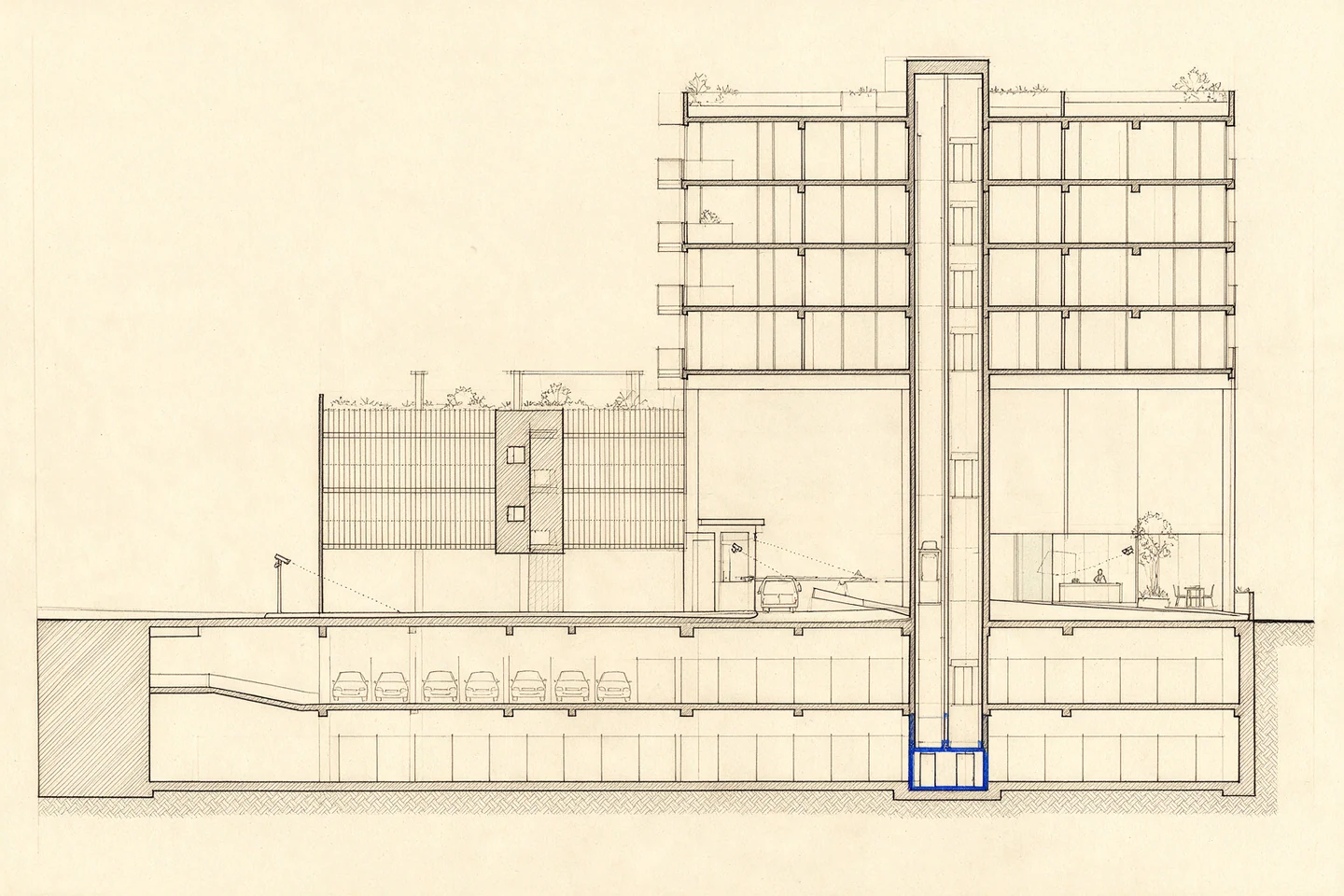
Whether the development is one strata body or several matters here as it does in Mont Kiara, but it is not the hard part. The hard part is that a city-centre tower is attached to something — an office block, a retail podium, a hotel, a public car park, or all four — and every attachment is a place where someone else’s traffic reaches you.
Who is allowed to park in your car park?
That depends on each bay’s status on the strata plan, not on what the building’s own records say. The Strata Management Act 2013 defines an accessory parcel only by reference to section 4 of the Strata Titles Act 1985, and limited common property by reference to a comprehensive resolution under section 17A of that Act. A bay is therefore an accessory parcel, common property or limited common property, and each gives a different answer.
The incumbent Malaysian answer, a vendor blog, states the starting point: where a bay is registered as an accessory parcel, the owner has exclusive use of it, though exclusive use is not unrestricted use. The operational consequence is the whole of enforcement: unless the building can tell which bay is appurtenant to which parcel, it cannot act on any of it.
| Bay, by how it is held or designated | Who controls its use | What the access system has to know |
|---|---|---|
| Accessory parcel | The proprietor of the parcel it is appurtenant to | Which bay belongs to which unit, kept current as units are sold and let |
| Common property | The management body, under the by-laws | Which credential is entitled to it today, and who authorised that |
| Limited common property | The subsidiary management corporation for those parcels | Which group of parcels the bay serves, as a separate rule from the rest |
| Visitor bay | The management body, by licence to each driver | Who the host is, when the vehicle came in, and when it left |
Can a commercial car park operate inside a residential development?
Yes, on the right facts. In a decision reported in November 2024 the Court of Appeal held that operating a commercial car park business on accessory parcels is not a dealing under sections 34(2) and 69 of the Strata Titles Act 1985, because those provisions do not cover granting licences for temporary occupation to car-park customers. Where the bays are accessory parcels held by a car-park operator, a stranger’s car can be in your basement entirely legitimately.
The facts are not exotic. In Target Term Sdn Bhd v Waldorf and Windsor Management Corporation the developer sold one apartment unit together with 420 car park units to a related company so it could run a commercial car park business, and 414 of those bays were accessorised to that single unit. In 2017 the management corporation billed the owner for arrears in excess of RM850,000.
The Court of Appeal’s route was the Federal Court’s licence-or-tenancy test from Innab Salil v Verve Suites Mont’ Kiara Management Corporation: the first question is whether the occupier was granted exclusive possession, and if he was, the arrangement is highly likely to be a tenancy. A driver in a visitor bay has exclusive possession of nothing, so what he receives is “no more than a licence”. An earlier decision on 439 car park parcels, Ideal Advantage, went the other way and was distinguished.
The Court also declined to treat the bays as common property merely because of how they were used, holding that “it is a fundamental rule of drafting that if rights and obligations are intended to be created or annulled by a provision of law, the same must be set out in the body of the legislation, and not merely postulated based on the definition of a phrase”. For a committee the reading is narrow and important: you may not be able to stop the traffic, so the boundary you can defend is the one inside the lift.
What can the building do about a car that should not be there?
More than most committees use. Under Third Schedule by-law 25(2) the management may tow away or wheel-clamp an unauthorised vehicle in common property, or any vehicle parked outside its designated bay or in a bay designated for another proprietor, at the owner’s cost and without prior notice. The clamp charge is capped at two hundred ringgit plus the towing and holding costs actually incurred.
By-law 25(1) covers the ordinary case — properly parked, no obstruction — and by-law 25(5) lets the building clear equipment and rubbish out of the car park without notice. On the people side, by-law 17(1) allows the management to require any person on the common property to identify himself for security purposes, and 17(2) to require anyone who refuses and is not a proprietor to leave immediately. A resident’s guest is not outside the by-laws either: the Third Schedule reads every reference to a proprietor as including his lessee, tenant, occupier or invitee.
Every one of those powers is a record problem before it is a security problem. You cannot clamp a car for being in another proprietor’s bay unless you can say whose bay it is, and a tag or a plate read at the barrier is what turns the by-law into something a building manager can act on at eight in the morning. The same is true at the lobby: registering a visitor is only worth the effort if the register will still answer a question three weeks later.
What do the cameras actually have to be able to see?
Specify a level of detail, then the resolution that delivers it. The Singapore Police Force standard defines four, each with a detail criterion on the subject: Detect at 40mm per pixel, Observe at 16mm, Recognise at 8mm and Identify at 4mm per pixel, which is the level at which identity can be established beyond reasonable doubt. No single camera view delivers both ends of that range.
| Level | Detail on the subject | What you get | Where it belongs |
|---|---|---|---|
| Detect | 40mm per pixel | After a search, whether a person is there at all | Long basement aisles, ramps, perimeter |
| Observe | 16mm per pixel | Distinctive clothing, and the activity around an incident | Lift lobbies, podium links, loading bays |
| Recognise | 8mm per pixel | Whether this is the same person you saw before | Residential entrance doors, turnstiles |
| Identify | 4mm per pixel | Identity established beyond reasonable doubt | The visitor counter, one camera, close in |
The standard is specific about what a city-centre tower keeps getting wrong. Car parks, loading bays and vehicle boarding and alighting points all need enough cameras for comprehensive coverage. Where lifts act as an alternate way into the building — which, over a podium, they always do — the lift doors and lobby are to be monitored at Observation level. And at a vehicle entrance the camera should be mounted where it cannot be evaded, damaged or obscured, “looking towards, rather than down at the doorway or driver”.
That last requirement collides with the building. The Uniform Building By-Laws 1984 set the minimum height of a basement at 2.5 metres — which is why a basement that reads plates well is a design, not a product. Plate capture is a recording, so how many days your recorder really holds decides whether it is still evidence when asked for, and the lobby register is personal data from the moment it exists.
What changed outside the gate in 2026, and what does it not cover?
In April 2026 Kuala Lumpur City Hall, working with the police, installed smart CCTV cameras around KLCC to strengthen monitoring and provide a safer environment for visitors. The system is designed to monitor high-risk zones continuously, detect suspicious behaviour, assist with facial recognition and identify unlicensed activities.
Knowing precisely what the DBKL system does matters, because residents will assume more. It also manages traffic offences along Jalan Ampang and carries loudspeaker alerts and panic buttons linked directly to the Kuala Lumpur Command and Control Centre and DBKL’s operations room. That is a public-realm system with a public-realm operator. Your basement, lift lobby, riser and intercom are not in it, and a panic button on your own property still has to reach somebody who answers.
What should a KLCC or Jalan Tun Razak committee settle before anyone prices the work?
Four things, in writing. Which bays are accessory parcels and which are common property. Where the residential boundary sits once a podium shares the basement. What level of detail each camera position has to deliver. And what the maintenance contract obliges when a reader or a barrier fails. The Singapore standard also asks for a minimum of 20% spare capacity designed in from the start.
Availability is the figure buildings never fix. That standard sets system availability at 95% over a twelve-month frame and asks for faults to be rectified within 24 hours — and 95% of a year still leaves about eighteen days of outage. No Malaysian rule sets an availability or rectification figure, so whatever your contract does not say, nobody owes you. The vendor pages do not help: the condominium page a competitor ranks for is a menu of features organised around products rather than the decision in front of a committee.
Occhio Tec is an Extra Low Voltage contractor established in 2012, designing, installing and maintaining CCTV, access control, video intercom, structured networking and perimeter intrusion for condominiums in Mont Kiara, Bangsar and KLCC, including systems another contractor installed. Where podium and tower are on different vendors, the argument for every layer under one contractor is about who owns the fault. Which bay belongs to which parcel, and where your defensible line runs, cannot be read off a drawing: request a site survey, or message +60 11-6494 4931.
Questions KLCC and city-centre committees ask
Q-01Can our management corporation stop an owner letting out his parking bay?
Not on the ground that letting someone park is an unlawful dealing. In a decision reported in November 2024, the Court of Appeal held that granting licences for temporary occupation to car-park customers is not a dealing under sections 34(2) and 69 of the Strata Titles Act 1985. Exclusive use of an accessory-parcel bay is still not unrestricted use, so what is left is the by-laws and the house rules.
Q-02Our car park is shared with an office podium. Where should the line be?
At the residential lift lobby rather than the car-park entrance, because podium traffic has a lawful reason to be in the basement. The Singapore Police Force standard treats lifts as an alternate way into a building and asks for the lift doors and lobby to be monitored at Observation level, a detail criterion of 16mm per pixel on the subject.
Q-03DBKL has installed cameras around KLCC. Do we still need our own?
Yes. The April 2026 deployment is a public-realm system: smart CCTV around KLCC, loudspeaker alerts and panic buttons linked to the Kuala Lumpur Command and Control Centre and DBKL’s operations room. The building standard still expects comprehensive coverage of your own car parks, loading bays and vehicle boarding and alighting points, inside your boundary.