
CCTV in Malaysia: A Complete Guide to Cameras, Recording and Installation.
QUESTION ANSWEREDWe are buying, replacing or fixing CCTV for a building. What are the parts, which cameras go where, how many days must it keep, what do Malaysian rules say, and what decides the cost?
A CCTV system is cameras, the cabling that carries their pictures, a recorder that keeps the footage for a set number of days, and a place to watch and retrieve it. For a Malaysian building, decide what each camera must show, how many days to keep, and who maintains it before choosing any equipment.
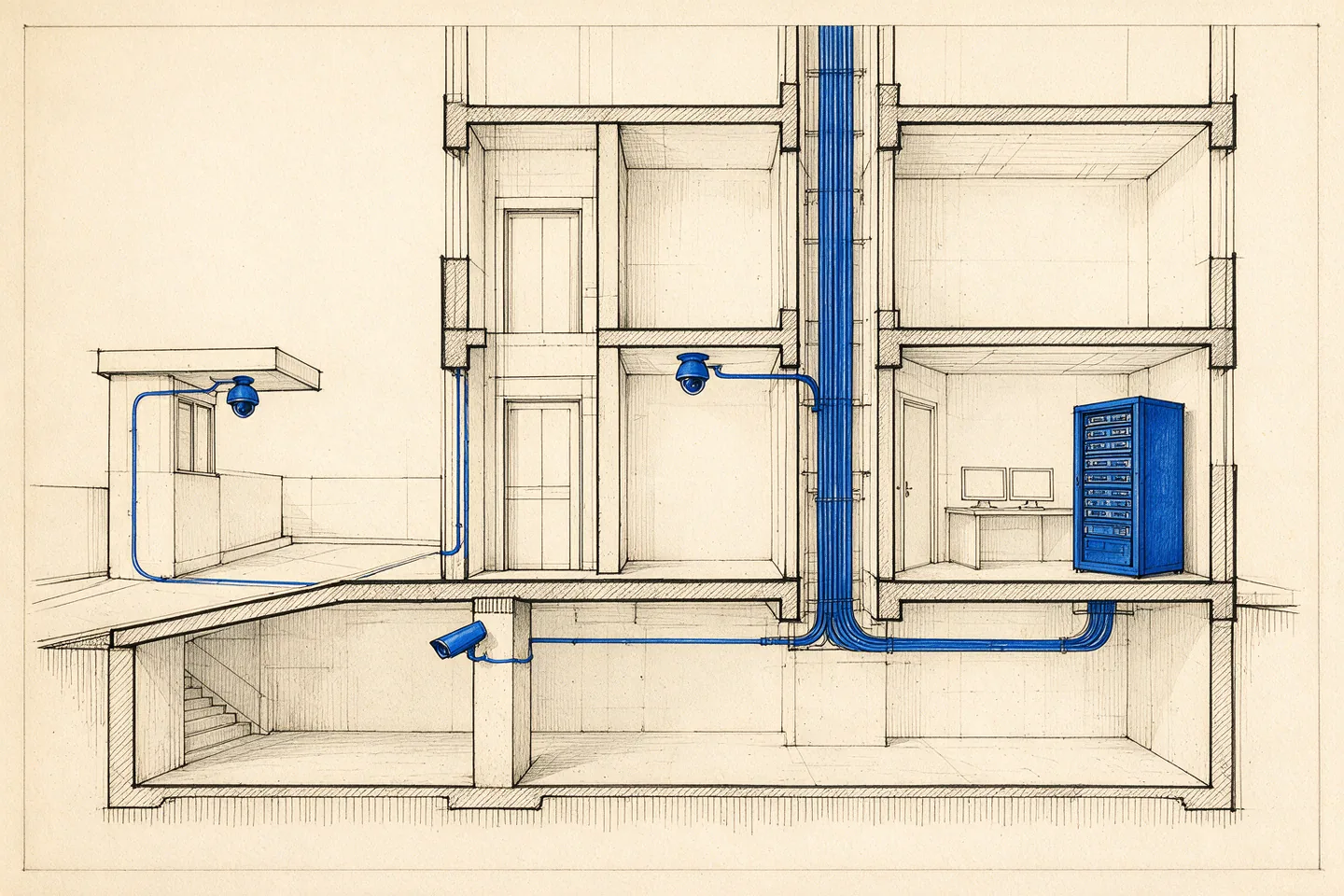
- 01Specify what each camera must show (detect, observe, recognise or identify), not a megapixel countTHE SPEC
- 02PLANMalaysia’s CCTV guideline asks business premises for at least 31 days of recording on every cameraTHE DAYS
- 03Storage, not cameras, is where a building’s days are won or lost: work the sum before you buyTHE SUM
- 04The same guideline asks for every camera to be maintained at least once every three monthsTHE UPKEEP
- 05Since 1 April 2025, breaking a data protection principle can cost up to RM1 millionTHE LAW
- 01What CCTV is and how it works§01
- 02The parts of a system§02
- 03Analogue or IP§03
- 04Camera types and where each fits§04
- 05How much detail a camera needs§05
- 06How many days to keep§06
- 07Storage: a worked example in ringgit§07
- 08Malaysian law and guidelines§08
- 09CCTV signs§09
- 10Wireless CCTV and the internet§10
- 11Installation, step by step§11
- 12What decides the cost§12
- 13Maintenance§13
- 14Lifespan, repair or replace§14
- 15Common mistakes§15
- 16When the usual advice does not apply§16
- 17What has changed lately§17
- QQuestions committees askF-A
ON THIS SHEET18 SECTIONS
What is a CCTV system and how does it work?
A CCTV system records what its cameras see so that a moment can be found and replayed later. PLANMalaysia’s guideline on CCTV defines it as a surveillance system of cameras and related equipment for monitoring, transmitting and controlling particular security zones. In a building it is one layer among several, which is why our guide ELV systems in Malaysian buildings: every layer, one contractor treats it alongside access control and intercom.
The working chain is short. A camera turns light into a picture. A cable, or sometimes a radio link, carries that picture to a recorder. The recorder writes it to hard disks, overwriting the oldest day when the disks are full. A guard or the management office watches live on a monitor and, after an incident, searches the recording for one camera at one time.
It is not a guard. The Singapore Police Force’s standard for buildings says a video surveillance system “should not be designed to serve as the sole protective measure in a specified area”, but should work with access control, intrusion detection and a security response. In practice most of a building’s cameras are watched by nobody most of the time, so the system earns its keep after the event, when someone needs one clip.
Whether that clip exists is settled long before the incident: by what the camera was specified to show, how many days the disks hold, and whether anyone checks the system still records. Those three decisions run through the rest of this guide. Our page on CCTV for Kuala Lumpur condominiums describes the service itself.
What are the parts of a CCTV system?
Five parts: cameras, the cabling and network that carry the pictures, the recorder and its disks, the monitoring point, and the power that keeps them running. Each can fail on its own, and a fault in any one of them can leave a building with no footage even when every camera looks fine.
| Part | What it does | What to ask about it |
|---|---|---|
| Cameras | Capture the picture at each position | What must this position show, by day and by night? |
| Cabling and network | Carry video (and often power) from each camera to the recorder | What is already in the risers, and is there spare capacity? |
| Recorder and disks | Write every camera to disk around the clock and play it back | How many days does it hold, and what happens when a disk fails? |
| Monitoring point | Where a guard watches live and staff retrieve clips | Who may view and export footage, and how is it logged? |
| Power | Keeps cameras and recorder running, including through a blackout | Is there backup power, and how long does it last? |
The recorder is where most of the risk sits. PLANMalaysia’s guideline asks for recorders made for the security industry that can run 24 hours a day, 7 days a week, with playback that does not interrupt recording, and for the recorders and storage to sit “di lokasi yang terkawal dan selamat”, a controlled and secure location. A recorder on a shelf in the guardhouse fails that test.
Power is the part most often forgotten. An IP camera can take its power down the same network cable as its video, a method called Power over Ethernet. The original standard provides up to 15.4 W per port, the PoE+ version up to 25.5 W, and the newest types up to 51 W and 71.3 W. A camera with heaters, strong infrared or motorised zoom may need the higher classes, so check each camera’s draw against the switch.
The security control room is the human end of the chain. What it needs is set out in our guide to the condominium security control room.
Analogue or IP: which kind of CCTV should a building have?
For an existing building, the cabling already in the risers usually decides. Analogue cameras send video over coaxial cable to a DVR (digital video recorder); IP cameras send it over a data network to an NVR (network video recorder). IP gives more detail per camera and carries power on the same cable; modern analogue can reuse sound coaxial cable at lower cost.
That is why the question is rarely which is better, and usually what is already in the riser and what it would cost to replace. Cameras are quick to change. Cable runs through slabs and risers are not. Many buildings end up with a mix: new IP cameras where the cable has been renewed, analogue where the old coax still works, both feeding one monitoring point.
A mixed system is not a failure. Occhio Tec’s own position is that strata buildings “inherit whatever the developer or the last contractor installed, so working across brands is what lets us repair rather than replace”. The full comparison, including what each means for a funding submission, is in analogue versus IP CCTV for a condominium.
Which camera types suit which spot?
Choose the camera for the position, not the other way round. A fixed dome suits most indoor and covered positions, a bullet suits a long view such as a ramp or a fence line, and a pan-tilt-zoom camera suits a wide area that a guard actively watches. Light, rain and the risk of tampering then decide the rest.
| Type or feature | Where it fits | What the guidance says |
|---|---|---|
| Fixed dome | Lobbies, lift lobbies, corridors, guardhouses | PLANMalaysia encourages dome cameras and asks for cameras that resist vandalism |
| Bullet | Driveways, ramps, perimeter fences | A long, narrow view; mount it out of reach |
| Pan-tilt-zoom (PTZ) | Wide open areas a guard watches live | The UK Home Office lists the cost, the extra operator work and that “they usually only cover a small area at a time” |
| Day/night with infrared | Unlit or poorly lit areas | Required by PLANMalaysia where lighting is absent or poor; the Home Office prefers more light where possible |
| Wide dynamic range | Cameras facing a doorway, a window or headlights | PLANMalaysia requires backlight compensation or wide dynamic range for a camera facing a light source |
Light matters more than the camera. The Home Office manual notes that most cameras work well below the 3 lux generally considered the minimum for security, but that pictures lose colour and detail as light falls. Its advice is to raise ambient light “in preference to the use of infrared cameras”, because infrared gives black-and-white pictures at night and a lit area deters as well as records.
Glare is the opposite problem. A camera looking out of a bright lobby door, or into car headlights on a ramp, sees a silhouette. The Home Office manual notes that reflected sunlight and car headlights cause flare. Wide dynamic range helps, and so does moving the camera so the light falls behind it rather than in front.
Outdoors in Malaysia, weather is the test. The Malaysian Meteorological Department describes the climate as uniform temperature, high humidity and copious rainfall. Read the enclosure rating carefully: under the IP code, water ratings “are not cumulative beyond IPX6”, so a camera rated IPX7 for immersion is not necessarily tested against the driving water jets of IPX6. A device that passes both is marked with both, such as IPX5/IPX7.
How much detail does a camera need to capture?
Enough to do the job at that position, which is stated as a level of view: detect, observe, recognise or identify. PLANMalaysia’s guideline builds a CCTV system on four functions, monitor, detect, recognise and identify, close to the four levels below, and a scope that names a level for each position is the one tool that makes three quotations comparable.
The levels are measured by how much of the picture a person fills, not by megapixels. The Singapore Police Force’s standard sets them out as a share of screen height, and the table below uses its figures. A guardhouse lane or a main entrance usually needs identification; a corridor or a lift lobby usually needs observation.
| Level | A person fills | What it lets you say | Typical building position |
|---|---|---|---|
| Detect | At least 10% of the screen height | Whether a person is there at all | Perimeter fence, roof, plant areas |
| Observe | 25% to 30% | What someone is wearing and doing, with the scene around them | Corridors, car park aisles, lift lobbies |
| Recognise | At least 50% | Whether this is someone you have seen before | Lobby counters, staircase doors |
| Identify | At least 120% | Who it is, beyond reasonable doubt | Main entrances, guardhouse lanes |
PLANMalaysia’s own test of a clear picture is practical: one that shows facial features and appearance, such as tattoos, moles and clothing, shows vehicle registration numbers clearly, and shows the surroundings in detail. The Singapore standard adds a floor of HD 1080p resolution. Neither says a higher pixel count fixes a camera placed too far away.
The difference between identification and observation decides camera count and position more than any brochure. How to write those levels into a tender is set out in our guide to writing a scope of works for a CCTV tender.
How many days should CCTV keep its footage?
For a business premises, PLANMalaysia’s guideline asks that every camera can keep at least 31 days of recording and run continuously; for public places, 45 days. No Malaysian statute we checked sets a number of days, and the guideline itself is a guideline, not a law. A building that keeps 31 days is following the only Malaysian figure on paper.
The guideline’s wording for business premises is that “Setiap kamera dalam sistem CCTV berkeupayaan menyimpan rakaman minimum selama 31 hari dan beroperasi sepanjang masa”: every camera able to store at least 31 days and operate around the clock. The Singapore Police Force recommends the same 31 days or more for buildings, with at least 20% reserve recording media on top.
Keeping too long carries its own risk. Where the Personal Data Protection Act applies, its retention principle says personal data “shall not be kept longer than is necessary for the fulfilment of that purpose”. A fixed retention period that the building can explain, and a written rule for keeping an incident clip longer, answers both risks.
Most buildings hold fewer days than they think, because retention is simply disk space divided by what the cameras write each day. Add cameras or raise quality without adding disks and the days fall silently. Why that happens, and how to check yours, is in condominium CCTV footage retention in Malaysia.
How much storage does a building’s CCTV need? A worked example
Multiply what one camera writes in a day by the number of cameras and the number of days, then add a reserve. The figures below are an illustration with every input stated, not a measurement of any building: 48 cameras, each writing an average of 4 megabits a second, recording continuously. Your recorder’s settings page shows your own cameras’ rate.
| Step | Working | Result |
|---|---|---|
| One camera, one day | 4 megabits a second for every second of the day | 43.2 GB |
| Whole building, one day | 43.2 GB × 48 cameras | 2,073.6 GB |
| 14 days | 2,073.6 GB × 14 | About 29.0 TB |
| 31 days | 2,073.6 GB × 31 | About 64.3 TB |
| 31 days plus a 20% reserve | 64.3 TB × 1.2 | About 77.1 TB |
| 45 days (the public-place figure) | 2,073.6 GB × 45 | About 93.3 TB |
| Drives for 31 days plus reserve | 77.1 TB on 4 TB drives | 20 drives, about RM8,400 at RM420 each |
The ringgit figure uses the entry retail price of a 4 TB surveillance drive, about RM420, as Klang Valley installers list it (read 24 Nov 2026). It covers the drives alone: no RAID parity disk, no recorder, no labour. Larger drives change the count but not the shape of the sum, which is that the days a building keeps are bought in disks.
The lever is the rate each camera writes. Halve it to an average of 2 megabits a second and the same 31 days need about 32.1 TB, or 38.6 TB with the reserve: 10 drives, about RM4,200.
Encoding settings, frame rate and how busy the scene is are what move that rate, and a quiet corridor at night writes far less than a busy lobby at noon. Ask every bidder to state the average rate their cameras will write at your positions, and size the disks from that, not from a brochure.
Plan for a failed disk too. The Singapore standard asks for a minimum of RAID 5, so that when a bad disk is replaced the array rebuilds while recording carries on. A recorder with no redundancy loses whatever was on a disk that dies.
What do Malaysian law and guidelines say about CCTV?
Three sources matter: the Personal Data Protection Act 2010 for the footage, PLANMalaysia’s CCTV guideline for how systems at business premises and public places should be built, and, for condominiums, the Strata Management Act 2013 for who must keep the system working. None of them licenses CCTV as such.
The Personal Data Protection Act
The Personal Data Protection Department lists an “image in closed circuit recording (CCTV)” among its examples of personal data. The Act applies to personal data “in respect of commercial transactions”, so a shop, office or hotel recording customers is plainly inside it. Whether it reaches a JMB or MC running cameras for residents is not settled; condominium CCTV footage requests explains why, and how to handle footage as if it applies.
The stakes rose in 2025. Since 1 April 2025, contravening a data protection principle can bring a fine of up to one million ringgit, imprisonment of up to three years, or both. Since 1 June 2025, a data controller must appoint a data protection officer and, where it has reason to believe a personal data breach has occurred, notify the Commissioner as soon as practicable.
PLANMalaysia’s CCTV guideline
PLANMalaysia, the federal town planning department, published its guideline on installing CCTV at business premises and public places on 1 December 2010, under the Safe City programme, replacing a first edition of June 2007. It makes the local authority responsible for requiring CCTV in public buildings and business premises, and owners or managers of those premises responsible for installing, monitoring and maintaining their own systems.
Its list of business premises is specific: commercial banks and the surroundings of ATMs, gold shops, pawnshops, markets, money changers, shopping complexes, hotels, free-standing office buildings, petrol stations and premises open 24 hours. Public places include transport hubs, public car parks inside or outside buildings, schools, places of worship, public spaces in housing areas and public parks. A condominium’s own private common areas are named in neither list.
It also says where cameras may not look. Cameras installed under it may not cover homes, especially bedrooms and bathrooms, or the inside of changing rooms and public toilets. That is a sound rule for any building, and a committee that adopts it in writing has an answer ready when a resident asks where the cameras point.
The Strata Management Act
For a condominium, CCTV installed for the building is usually part of the common property. The Strata Management Act 2013 requires a JMB, and later the management corporation, to keep the common property “in a state of good and serviceable repair”. A recorder that has silently stopped recording is not in serviceable repair.
Does a building need a CCTV sign?
Put one up at every main entrance. PLANMalaysia’s guideline asks for signs at every main public access, stating the monitoring period, such as “KAWASAN PANTAUAN 24 JAM”, in text and symbols, and placed high, bright, readable and well lit. Where the Personal Data Protection Act applies, a sign is also the simplest way to tell people they are being recorded.
The guideline even sets the size. Its indoor sign is A3, 297 mm by 420 mm; its outdoor sign is B3, 353 mm by 500 mm and reflective, each with an amber triangle and a CCTV symbol. A building does not have to copy the design, but a sign of that size is read; a small sticker on a pillar is not.
The wording can be plain. Asked whether a sign must say the cameras are for security, the Personal Data Protection Department’s FAQ answers that a building can put up “a simple CCTV notice” about “Surveillance for Safety”. Pair the sign with a short written policy on who may view and release footage.
Can CCTV be wireless, and should it be on the internet?
It can be wireless, within MCMC’s radio rules, and it should be on a network of its own rather than the building’s shared one. For a building, cable is still the default and radio the exception, for a camera at a far gate or across a road where a cable cannot reasonably run.
MCMC’s SRSP-546 sets the requirements for wireless CCTV in the 5650 MHz to 5725 MHz band, and notes that other bands, such as 2400 MHz to 2500 MHz and 5725 MHz to 5875 MHz, may also carry it. The equipment “shall be certified under the Communications and Multimedia (Technical Standards) Regulations 2000”. Ask any bidder proposing a radio link which band it uses and for its certification.
Keep the system separate. PLANMalaysia’s guideline says a CCTV system should run on its own dedicated network, and the Singapore standard asks for the firmware of every component to be updated regularly “to minimise application security vulnerabilities”. Remote viewing for the management office is useful; a recorder exposed to the internet with its factory password is an open door.
Edge storage is a useful backstop. The Singapore standard notes that many IP cameras can record onto an onboard SD card, so a network failure does not interrupt recording, and that the recorder should fetch the missing footage once the network is back.
How is CCTV installed in a building, step by step?
In eight steps, and the cameras go up late in the sequence. Purpose, levels of view, days and cabling are settled first, on paper, so that every bidder prices the same system. Each step below is a line in the scope of works.
- State the purpose. PLANMalaysia asks for the purpose to be clear, crime prevention or traffic management, and notes that footage meant for law enforcement must meet minimum technical standards.
- Study the building. How people move through it, where the weak points are, and what the management is struggling with today.
- Set a level of view for each position. Detect, observe, recognise or identify, by day and by night.
- Set the days to keep. At least 31 is the Malaysian guideline figure for business premises; size the disks from it with a reserve.
- Plan the cabling, containment and power. Use what is sound in the risers, design new runs where it is not, and allow spare capacity; the Singapore standard asks for at least 20%.
- Place the recorder in a secure, controlled room, with backup power and surge protection.
- Commission and record the views. The Singapore standard asks for the agreed camera views and image quality to be documented and reviewed periodically.
- Hand over the drawings. As-built drawings, camera schedule, passwords held by the building, and the maintenance plan.
Step two is where buildings save money. Occhio Tec’s practice, from its company profile, is that it does not simply price cameras and card readers but studies the building first, and then chooses “technology that suits the building rather than the brochure”. A quotation written before anyone has walked the risers is a guess.
Step eight is where buildings lose money later. What Occhio Tec sees in older strata systems is equipment installed years ago “with no drawings, no records and no one who knows what is connected to what”. As-built drawings handed over on day one are what let the next contractor, or the next committee, repair rather than guess.
What decides what CCTV costs?
The cabling route, the recorder and its disks, and the number and type of cameras, roughly in that order. Cameras are the visible line in a quotation, but for a building the cable runs and the storage needed for the days it must keep usually decide the total.
Published prices online are for homes and small premises. Klang Valley installers published supplied-and-installed packages, read on 24 Nov 2026, at RM2,599 to RM2,899 for four cameras, RM3,099 to RM3,899 for eight and RM5,899 to RM7,899 for sixteen. Those prices assume short surface cable runs, reachable heights and a power point at the recorder; anything else is quoted on top.
Cabling alone shows why a building costs more per camera. The same price guides list a surface cable point at RM150 to RM250 and a concealed point at RM250 to RM500. In a tower, a camera on the twelfth-floor lift lobby is a run through the riser, not a point on a wall, and the worked example in §07 shows how quickly disks add up for 31 days.
Compare quotations line by line, not total by total: same positions, same levels of view, same days, same cabling. Our guide to comparing CCTV quotations for a condominium sets out the grid, and sinking fund or maintenance fee covers which account should pay.
How should CCTV be maintained?
On a schedule, and with a check that recording is still happening. PLANMalaysia’s guideline asks for every camera to be maintained at least once every three months, more often outdoors where cameras face rain, heat and dust, and for preventive maintenance every month.
Its maintenance list is a fair checklist for any building:
- camera performance and operation;
- the integrity of the metal housing and the working of any ventilation fan;
- cables and connections;
- the video server or recorder;
- lightning surge isolators, lightning arresters and video power surge protectors;
- firmware renewal, where there is any.
The recorder can do half of the watching. A typical network video recorder’s user manual lists exception alarms for “network disconnected, IP confliction, abnormal record, HDD error”, and disk health checks through S.M.A.R.T. and bad-sector detection. An alarm that sounds in an empty room is no alarm: route it to someone who will act, and see condominium CCTV not recording for what to do when it fires.
Storms are the Klang Valley’s particular risk. MetMalaysia data show the KLIA station recorded more than 300 days with lightning each year from 2015 to 2024. Whether surge protection devices are mandatory depends on a risk assessment, Suruhanjaya Tenaga says. Occhio Tec treats surge protection as a planning matter rather than a repair one; see lightning damage to condominium CCTV. What a contract should oblige is in what a security maintenance contract must cover.
How long does CCTV last, and when should it be replaced?
Not by a fixed number of years. The layers age differently: cameras and disks wear out first, recorders lose maker support, and cabling outlasts both. Replace a layer when it can no longer be repaired or supported, not because a contractor calls the whole system old.
“Is it really obsolete?” is the question Occhio Tec is asked most often, usually by a committee that has just been told the entire system must be replaced. In its experience, calling a system obsolete is very often what an inexperienced contractor says when they cannot work out how to fix it. Its published rule is: “We diagnose before we quote, and we repair rather than replace wherever the equipment still has life in it.”
A committee should be shown the condition of its own system before it pays for anything, so every ringgit can be explained to owners at the AGM. Our guides on how long a building’s CCTV, access control and intercom last and repair or replace an ageing building security system set out the signals to look for.
What mistakes do buildings make with CCTV?
Most of them are made at purchase and found at the first incident. These are the ones that recur:
- Buying megapixels instead of a level of view. A sharp camera too far from the door still cannot identify anyone.
- Never checking the days held. Cameras are added, the disks are not, and the days set at handover quietly fall.
- Treating live pictures as proof of recording. The guardhouse monitor can show live video from a recorder that has stopped writing to disk.
- Reading IPX7 as better than IPX6. The water ratings are not cumulative beyond IPX6.
- Lighting with infrared alone. Black-and-white night pictures lose the clothing colour a witness remembers.
- Leaving no drawings. The next contractor starts by guessing what is connected to what.
- No written footage policy. The first request from the police or a resident is answered in a hurry.
The cost of these shows up as what Occhio Tec hears from committees after damage to common property: “no usable footage when the committee asks who did it”. Every item above is cheaper to fix before the incident than after.
When does the usual advice not apply?
When the building is not an ordinary residential one, or the position is not an ordinary position. The figures in this guide are starting points, and four cases move them.
- Business premises on PLANMalaysia’s list. A bank, gold shop, pawnshop, hotel or 24-hour premises may be required by its local authority to install CCTV, and the guideline’s 31 days and technical appendix then apply directly, not as a model.
- Public places and public car parks. The guideline’s figure rises to 45 days per camera, which in the worked example is about 93.3 TB instead of 64.3 TB.
- Car park entrances. A camera that must read number plates is a different design problem from one that watches people; see condominium car park entry.
- Back lanes and five-foot ways. For business premises the guideline says high-risk areas such as back lanes, side lanes and the five-foot way “mestilah dilitupi oleh kamera CCTV”: they must be covered.
Housing schemes sit outside both lists. The guideline only says CCTV in housing areas is encouraged, which leaves a condominium free to set its own days and levels, and responsible for justifying them to owners.
What has changed lately?
The law caught up with the footage in 2025, and the cameras got smarter. The penalty for breaking a data protection principle rose to up to RM1 million from 1 April 2025, and the duties to appoint a data protection officer and report breaches began on 1 June 2025.
On the equipment side, the questions have moved from the camera to the recorder and the network: how much each camera writes, how the disks are protected, and whether firmware is kept up to date. Video analytics have moved from the brochure into ordinary systems: Occhio Tec’s CCTV work includes AI-based analytics for intrusion, loitering and crowd detection. PLANMalaysia’s guideline already asked in 2010 that analytics follow the relevant MS/ISO/IEC minimum standards.
What has not changed is the order of decisions. Purpose, level of view, days, cabling and maintenance come before brand and resolution, and a system specified that way still works when the next codec arrives.
How does Occhio Tec work on CCTV?
Occhio Tec, established 2012, designs, installs and maintains CCTV for high-rise condominiums and commercial buildings, mainly in Mont Kiara, Bangsar and KLCC, as one of the multiple systems it looks after in a building. Its CCTV work covers IP and analogue cameras, NVRs and DVRs, video management software, storage sizing and retention planning, and AI-based video analytics.
It diagnoses before it quotes and repairs before it replaces, and it also takes over systems another contractor installed. Letters from building managers on our work page name CCTV surveillance among the systems. If your building is planning, replacing or fixing CCTV, request a site survey.
Questions committees ask about CCTV
Q-01What frame rate should CCTV record at?
Enough to catch the movement at that position. The Singapore Police Force recommends at least 6 frames a second indoors and 12 outdoors for slow traffic, and the UK Home Office notes that 6 to 12 frames a second is common for recorded CCTV against 25 for broadcast video. PLANMalaysia’s guideline asks for transmission and playback of at least 25 frames a second at 4CIF resolution.
Q-02Is a 4K camera always better?
No. A level of view depends on how much of the picture a person fills, so a 4K camera too far from a door can still fail to identify anyone, while writing more data and shortening the days your disks hold. Choose the level of view for the position first, then the resolution that reaches it at that distance.
Q-03Should the CCTV recorder have backup power?
Yes. A blackout is when a building most needs its cameras, and a recorder that loses power can also corrupt the disk it was writing to. The Singapore standard asks for an uninterruptible power supply with at least 30 minutes of backup for the video management system, recorders and viewing terminals.
Q-04How do we stop an incident clip being overwritten?
Export it at once, and protect it on the recorder. Recorders can usually lock footage: a typical network video recorder’s manual, for example, explains that a disk can be set read-only “to prevent important recorded files from being overwritten”, and that a redundancy disk can record alongside the main one. Make the request in writing, naming the cameras and the hours.
Q-05Can a building camera look into a unit or a toilet?
It should not. PLANMalaysia’s guideline bars cameras installed under it from covering homes, especially bedrooms and bathrooms, and the inside of changing rooms and public toilets. Where the Personal Data Protection Act applies, recording more than the purpose needs is also hard to justify. Aim each camera at common areas and record its view at commissioning.
Q-06Do we need a licence to install CCTV?
None of the sources in this guide creates a CCTV licence for a building. What applies is narrower: a wireless link must use certified equipment under MCMC’s rules, premises on PLANMalaysia’s list may be required by their local authority to install CCTV, and the footage falls under the Personal Data Protection Act where it applies.