
One Contractor or Five? Splitting Condominium Security Systems.
QUESTION ANSWEREDOur CCTV, access control, barrier and intercom are each on a different contractor. Is that a problem, and what should we do about it?
Splitting a building’s ELV systems between several contractors is normal and often unavoidable. What causes trouble is the layer none of them owns: the cables, ducts, network and power every system shares. Under the 2015 strata by-laws that shared layer is the management body’s own duty — so unless one contract names who answers for it, the building answers for it.
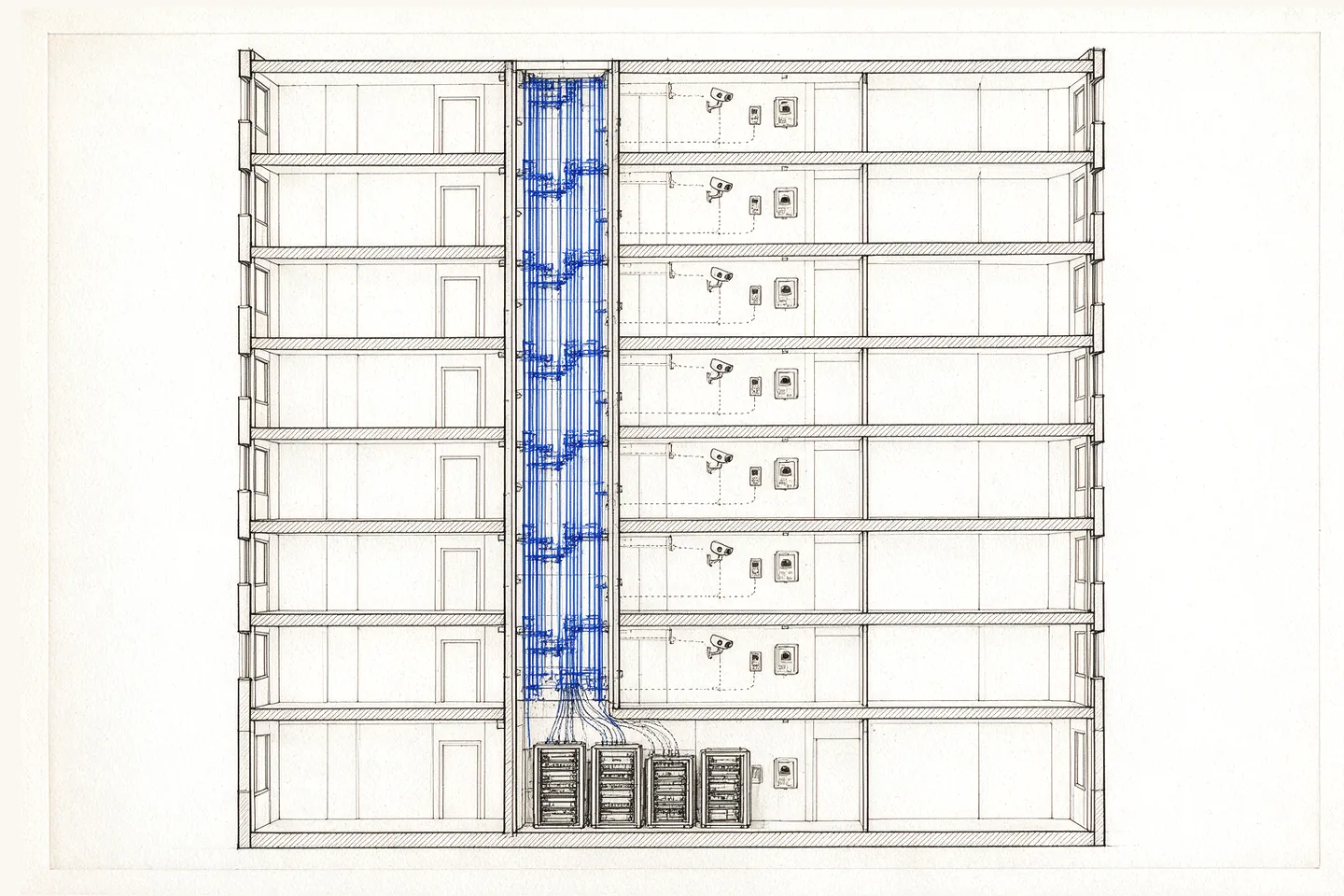
- 01By-law 3(2) of the Third Schedule to the 2015 strata regulations makes maintaining the wires, cables and ducts serving more than one parcel the building’s own function — by-law 1(1) binds a JMB, an MC and a subsidiary MC alikeTHE SHARED LAYER
- 02Section 21(1)(a) of the Strata Management Act 2013 puts the duty to keep the common property in good and serviceable repair on the joint management body, not on whoever last quoted for a cameraWHO ANSWERS
- 03Singapore’s police standard for video surveillance in buildings makes the building’s own Security Manager responsible for the system meeting its operational requirements, and sets availability at 95% over 12 monthsTHE STANDARD AGREES
- 04Recorder clocks drift apart: the Home Office CCTV manual asks for a mechanism that keeps time and date accurateTHE QUIET FAULT
- 05Some layers stay separate: regulation 19(4) of the Electricity Regulations 1994 restricts switchboard access to a competent personWHAT NOT TO MERGE
ON THIS SHEET07 SECTIONS
Why does a building end up with four security contractors?
A Kuala Lumpur high-rise ends up with four or five security contractors one procurement at a time: the developer’s contractor for the original ELV systems, then a separate award for each upgrade as the years pass. Five is not an exaggeration — access control, CCTV, intercom, networking and perimeter intrusion can each sit with a different firm. How a building arrives there is on every layer, one contractor. Nobody chose a split; it accumulated, and each decision was reasonable on the day.
Each contract is written around its own equipment, which is what makes them comparable and cheap. This page is the other half of that argument: the gap between the condominium security contracts a building already holds, whether or not it ever consolidates them. Occhio Tec, established 2012, works every one of those layers in Kuala Lumpur high-rise buildings and takes over systems another contractor installed. To have the gap in your own building found and written down, request a site survey, or message +60 11-6494 4931.
Who answers for a fault that lives in the shared layer?
A fault in the shared layer has no owner unless a contract names one, and by default the building owns it. Section 21(1)(a) of the Strata Management Act 2013 makes it the duty of a joint management body to properly maintain and manage the building and the common property, and keep it in a state of good and serviceable repair.
A contractor’s duty runs to its own equipment and its scope of works; the residue is the building’s. Singapore’s police standard for video surveillance in buildings — another jurisdiction’s, and useful here for its reasoning rather than its force — reaches the same conclusion:
The building’s Security Manager should be responsible for the proper implementation of the VSS to meet the operational requirements.
That is not a loophole in the contracts; it is what the contracts are for.
What does a shared-layer fault look like?
A shared-layer fault looks like a fault every contractor can prove is not theirs. Three ordinary ones show how the gap behaves.
- Between the access scope and the barrier scope. The card reads and the arm does not lift. Each contractor demonstrates their own half working, because the relay, the cable between them and the configuration at each end are named in neither agreement. Why a credential can be read and still not work is in why a condominium access card stops working.
- Outside every scope: the network. Cameras drop off whenever another system is busy, because a switch, an uplink or a power budget is at its limit. Each contractor finds their own equipment healthy, and no agreement names the switch. How this one hides until footage is wanted is in condominium CCTV not recording.
- Caused under one scope, suffered under another. A new cable pull disturbs an old run, and the fault appears days later in a system whose contractor was never on site. Making good binds only the contractor whose agreement says so.
Each produces cost without resolution: two or three attendances, every one establishing that somebody else’s equipment is fine. The layers a fault can live in, and what to record before anyone attends, are in when a building’s security system starts failing.
How can a committee find out who owns what in its own building?
A committee can establish who owns what from paper it already holds, in an afternoon, without asking anyone for a price. The output is one page — a demarcation register — and at the next tender it is worth more than a quotation.
- List every live contract that touches an ELV system, with its scope of works and expiry date beside it.
- List every head-end — recorders, access controllers, intercom exchange, network cabinets — and where each physically stands.
- Write against each head-end which contract covers it. The ones with no contract beside them are the real finding.
- Do the same for the six shared items above: cabling, riser, network, power, time and the integration points each need a name or a blank.
- Collect the as-built drawings, the administrative credentials and the commissioning record — the surveillance standard expects the agreed camera views and image quality to be documented and reviewed periodically by the building owner. If the building holds none of them, that is a line too.
Where the equipment turns out to be well covered and the shared layer is not, the register shows it on one page. Knowing that before asking for prices is also what makes quotations comparable — the method is in how to compare security system quotations.
What should a contract say so a shared fault has an owner?
A contract gives a shared fault an owner by naming the shared layer in the scope and obliging attendance even when the fault belongs elsewhere. Five clauses do the work, and they go into a contract a building already holds as easily as into a new one.
Which five clauses?
- Name the shared layer in the scope, each of the six with one party answering for it. A scope of works listing only equipment has already created the gap.
- Oblige attendance wherever the fault proves to be. Diagnosis then becomes the contractor’s problem, not the committee’s. What else a servicing agreement must oblige is in what a security maintenance contract must cover.
- Require an as-left record after every attendance: what was found, changed and left. That record is the building’s, not the contractor’s filing.
- Keep the administrative credentials with the building. Where four contractors hold four sets of credentials and the building holds none, a committee can find it cannot change supplier without replacing hardware.
- State one rectification clock for the whole system. The Singapore Police Force’s Video Surveillance System Standard for Buildings asks for faults to be rectified within 24 hours, sooner where coverage is seriously lost, and sets availability at 95% over 12 months — yardsticks for your own tender, not promises to ask a contractor to make.
Two further numbers from that standard are shared-layer provisions and belong in the same document: an uninterrupted power supply with at least 30 minutes of backup for the recorders and viewing terminals, and a minimum of 20% spare capacity. Turning all of it into a tender is covered in the scope of works for a condominium CCTV tender.
When is keeping the systems split the right answer?
Keeping the systems split is right whenever a layer is a different trade, under a different legal regime, or still covered by somebody else’s liability. Three cases should stay separate on purpose: work the law reserves to a competent person, systems carrying their own statutory approvals such as fire detection and lifts, and equipment still inside a developer’s defect liability period.
- Work reserved to a competent person. Regulation 19(4) of the Electricity Regulations 1994 restricts access to any part of a switchboard to a competent person, or someone under their immediate supervision. The supply side of a security installation is not an ELV contractor’s to adopt.
- Systems under their own statutory regime. Fire detection and lift installations carry their own approvals and inspection duties. An ELV contract should state where it stops and what it must not disturb.
- Equipment still inside somebody else’s liability period. Where a developer’s contractor remains liable for defects, taking the system over early can cost the building that cover — see what a JMB inherits at developer handover.
A fourth reason is about position rather than engineering: several suppliers means several prices to compare each year, and one supplier can become one the building cannot leave. That risk is answered by contract rather than by contractor count — credentials and documentation held by the building, standards-based cabling, a stated term and exit. The pillar sets out how to design out dependence on a single supplier.
By-law 3(7) of the same Third Schedule requires proper procurement procedures and a tender process, fair and transparent, for all awards of contracts connected with maintaining the common property. It says nothing about how many contracts there should be: one, three or five is the committee’s decision, and the by-law asks only that it be made properly and on the record.
What does one contractor across every layer actually change?
One contractor across every layer changes who has to diagnose a shared fault: the building stops being the integrator of last resort. What it does not change is just as worth saying, and the two sit side by side.
| Several contracts | One contract | |
|---|---|---|
| A shared-layer fault | Belongs to nobody unless a contract says otherwise | Belongs to the party that signed |
| Who diagnoses | The building, between attendances | The contractor, before attending |
| Credentials | Held in several places, often none of them the building | Still only the building’s if the contract says so |
| Price pressure each year | Several prices to compare | One, unless the term and exit are stated |
| Dependence | Spread across suppliers | Designed out by contract, or not at all |
| The equipment and its cost | Unchanged | Unchanged |
| A scope naming the shared layer | Needed | Needed just as much |
| Statutory trades | Separate | Still separate |
Occhio Tec works on multiple systems in high-rise buildings: barrier, door and lift access; CCTV, analogue, IP and central monitoring; intercom; networking and fibre. Each layer is on the services register. The reach is Mont Kiara, Bangsar, KLCC, Desa Park City, Bukit Jalil, Petaling Jaya, Cyberjaya, Putrajaya and Klang, and still growing.
The manufacturer appointments it publishes cross the layers rather than sitting in one: Authorised System Installer for MicroEngine since 2014, on the access control side, and Panasonic Malaysia Authorised Strategic Partner for ELV works since 2015. Both are current.
Which way your own building should go depends on what the demarcation register turns up, and a register is only worth anything if it was written on site against the actual cabinets and routes — which is what to require of whoever is asked for one. The rest of the reading before that decision is on the guides and articles hub. Where the system was somebody else’s first, see takeover and maintenance of an existing system; whether the ageing half is worth keeping is in how long a building’s CCTV, access control and intercom last. Request a site survey, or message +60 11-6494 4931.
Questions committees ask about split contractors
Q-01Two contractors each say the fault is in the other’s equipment. Who pays for the attendances?
Whoever the contracts say, and if neither mentions a fault outside its own equipment, the building pays both. The clause worth adding before the next renewal obliges each contractor to attend and help establish the cause, with the charge settled by where the fault is finally found.
Q-02Can a new contractor work in a riser that holds another contractor’s cables?
Yes, because the riser is the building’s, not the incumbent’s. By-law 4 of the Third Schedule has the management corporation control, manage and administer the common property for the benefit of all the proprietors, so access is the building’s to grant; by-law 3(2) separately makes maintaining the cables and ducts in it the building’s own function. Require in return a record of what was disturbed and an obligation to make good, agreed before the work starts.
Q-03Our building has no as-built drawings. Can the boundary still be established?
It can, but by tracing on site rather than by reading, and the result becomes the building’s first as-built record. A building without drawings should require that of whoever it asks for a register, and should expect a run nobody knew about to come to light in the process.
Q-04We already use only one contractor. Does any of this still apply?
It applies to the scope, not the count. A single contractor can hold a contract that still names only equipment, leaving the cabling, riser, network, power, time source and integration points outside it exactly as four contracts would. Read the scope against those six shared items: if each has a party beside it, the count was never the issue.