
ELV Riser vs TEL Riser vs Electrical Riser in a Condominium.
QUESTION ANSWEREDOur quotation mentions an ELV riser, a TEL riser and an electrical riser. What is the difference, who answers for each, and why does what is inside decide our upgrade?
An electrical riser carries the building’s mains power, a TEL riser carries the telephone and telecommunications lines, and an ELV riser carries the building’s own cabling for CCTV, access control, intercom and networking. Wiring codes keep power and signal out of one wiring system unless segregated. Shared risers are common property, and what already sits in the ELV riser decides how an ageing security system can be upgraded.
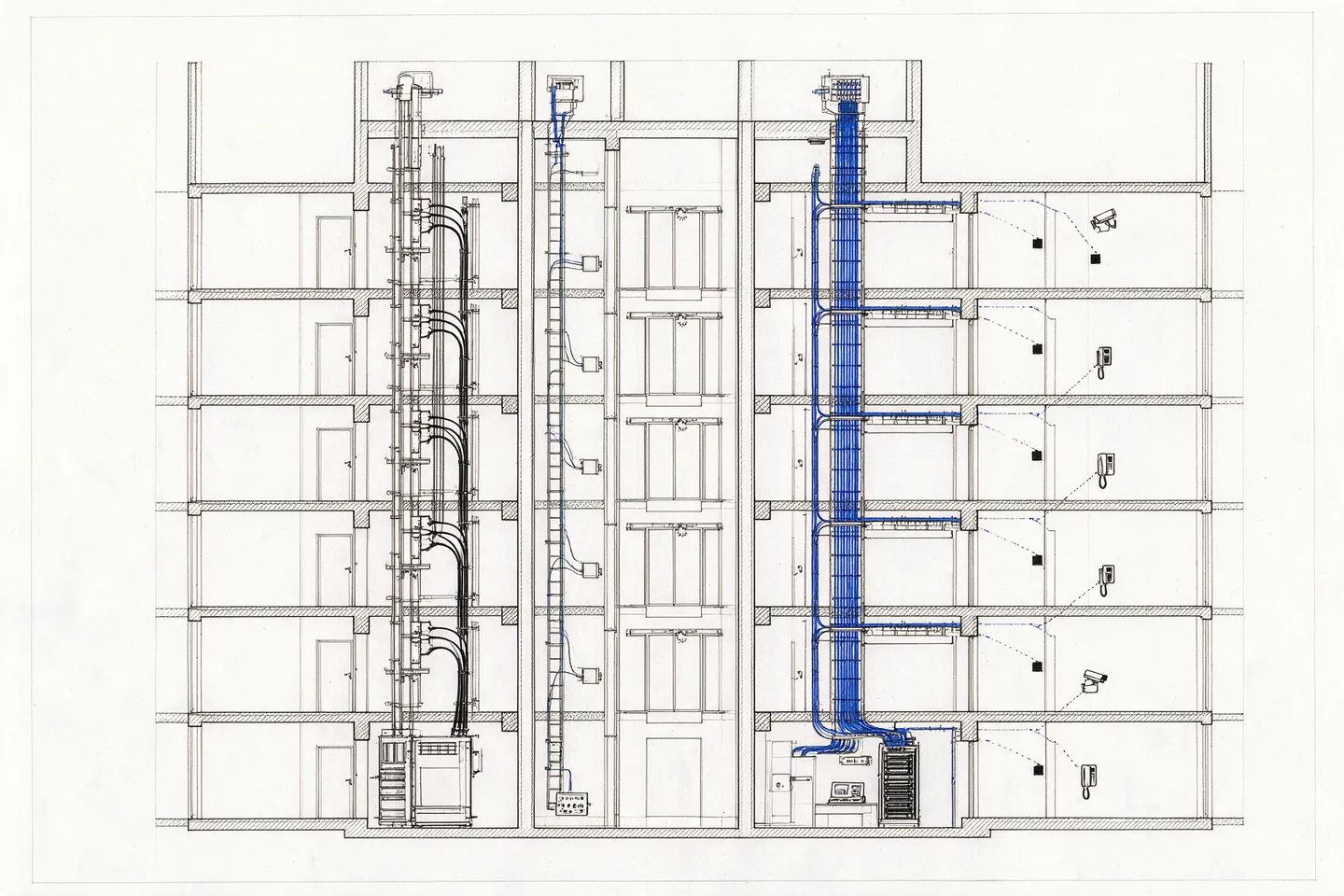
- 01Electrical riser: power. TEL riser: telecoms lines. ELV riser: the building’s security and network cablingTHREE JOBS
- 02Wiring codes keep signal circuits out of the same wiring system as power unless properly segregatedKEPT APART
- 03A shared riser is common property the JMB or MC must keep in good and serviceable repairYOURS TO MAINTAIN
- 04The MCMC opposes exclusive telco deals in high-rise buildings, so a committee should not hand one provider sole use of the TEL riserNO EXCLUSIVITY
- 05The cable already in the ELV riser decides what an upgrade costs in disruptionTHE CABLE DECIDES
ON THIS SHEET06 SECTIONS
What is the difference between an ELV riser, a TEL riser and an electrical riser?
An electrical riser carries mains power, a TEL riser carries telephone and telecommunications cables, and an ELV riser carries the building’s own CCTV, access, intercom, alarm and network cabling. How those systems work together is set out in Integrated ELV Systems — Every Layer, One Contractor.
| Riser | What it carries |
|---|---|
| Electrical (ELEC) | Submain cables and rising mains feeding each floor and the roof plant |
| Telecoms (TEL) | Telephone and telecommunications cables and equipment |
| Extra-low voltage (ELV) | The building’s own CCTV, door and lift access, intercom, alarm and network cabling |
Drawings are not always this neat. Lee, author of the Electrical Installations blog, notes: “In many building design, a single riser shaft is used to run all the ELV (extra low voltage) services to the upper floors.” On his example layout, any CCTV cable runs in the MATV (master antenna television) shaft. What is inside matters more than the label.
Why are power and signal cables kept apart?
Power and signal cables are kept apart because wiring codes say a signal circuit should not share a wiring system with a power circuit unless the two are segregated. Extra-low voltage means no more than 50 V a.c. or 120 V ripple-free d.c.
Two published codes state the principle, and neither is Malaysian law. The UK wiring regulations, as NICEIC explains them, say a Band I circuit (telecoms, alarms, ELV, voice and data) should not share a wiring system with a Band II power circuit unless Regulation 528.1’s segregation is met, by a separate compartment of trunking or a separate system. Hong Kong’s EMSD agrees. So a quotation routing new camera or intercom cable through the electrical riser should say how it is segregated.
Who is responsible for each riser in a condominium?
The management body must keep the common-property risers in good repair. Under the Strata Management Act 2013, common property is the part of the lot outside any parcel that occupiers of two or more parcels use or can use. Section 21(1)(a) requires a JMB, and section 59(1)(a) an MC, to keep it “in a state of good and serviceable repair”. That is also why riser keys belong in a key management system.
The TEL riser adds a second party. On 17 August 2020 the MCMC and the Malaysia Competition Commission said exclusivity arrangements between telcos and developers or building management companies in high-rise buildings deprive residents of a choice of provider; the MCMC’s GPP-I guideline prohibits them in new developments. On 5 December 2023 the Dewan Negara heard that the MCMC is seeking JMBs’ cooperation to let in-building coverage systems into high-rise buildings. The committee usually controls access, but should not give one provider the key.
What is the ELV backbone, and how far can its cables run?
In this guide, the ELV backbone means the main cabling running up the ELV riser from the control room to each floor, and its reach depends on the cable. A copper Ethernet run is limited to 100 m, so a camera or reader further than that from its switch needs another link.
Analogue CCTV is different. RG-59 coax is by far the most common cable in analogue installations, and on it CCTV Camera Pros’ cable-distance guide rates analogue HD cameras on it: HD-TVI cameras to 500 metres, AHD and HDCVI cameras to 300 metres. Security Info Watch notes most new deployments are IP, but a tower wired for coax still has coax in its riser.
How does what is already in the riser decide the upgrade?
What is already in the ELV riser decides how much of an upgrade is device work and how much is building work. New cable through an occupied building can mean drilling, routing and wall work around residents, so every cable that can stay is disruption avoided. We make the CCTV case in Analogue vs IP CCTV; the same holds for the intercom and access cabling.
| Found in the ELV riser | What it allows | Typical disruption |
|---|---|---|
| Coax from analogue CCTV, in good condition | HD-over-coax: cameras and recorder change, the coax stays | Low |
| Coax, but the committee wants IP | New network cable or fibre runs | Medium to high |
| Old intercom pairs | A replacement that reuses the existing route, if it performs reliably on that wiring | Low, if the route proves serviceable |
| Full trays, no spare containment | Usually new containment before new cable | High |
Reuse has limits: older lines can have little power available, long runs and signal loss. When one stack of units loses its intercom together, look in the riser, as our guide to an intercom that has stopped working explains.
What should a committee settle before anyone opens the riser?
A committee should settle four things before the riser is opened: who holds the keys, how every fire stop opened is resealed, what spare capacity the job leaves, and how the new cable is recorded. Each becomes the building’s problem afterwards.
- Keys: who holds them, and who signs them out and back.
- Fire stops: the seals (by-law 133) that stop smoke or flame passing where a cable crosses a wall or floor. Put the resealing of every penetration opened in the quotation.
- Spare capacity: by-law 123 of the Uniform Building By-Laws 1984 requires service ducts to allow access so repairs, extensions and modifications can be made. Ask what space the job leaves for the next one.
- A record: each new cable labelled and marked on the drawings.
Occhio Tec, established 2012, designs, installs and maintains the systems in the ELV riser: barrier, door and lift access; CCTV, analogue and IP; intercom; and networking and fibre. We also take over and maintain systems another contractor installed. If several vendors already share your riser, read one contractor or five. What is inside the shaft cannot be read off a drawing: request a site survey.
Questions committees ask about risers
Q-01Can our building give one telco sole use of the TEL riser?
It should not. In August 2020 the MCMC and the Malaysia Competition Commission warned that exclusive deals between telcos and building management companies could draw action under the Communications and Multimedia Act 1998 or the Competition Act 2010, and the MCMC’s GPP-I guideline prohibits them in new developments.
Q-02Can a resident run a CCTV cable through the riser?
Normally not. A riser that serves more than one parcel is common property under the Strata Management Act 2013, which the JMB or MC must maintain, so work in it needs the committee’s permission. ClickBina’s Malaysian condo wiring guide notes risers are normally locked.
Q-03What is the ELV backbone?
In this guide, the main cabling running up the ELV riser from the control room to each floor. Its reach depends on the cable: a copper Ethernet run is limited to 100 m, while CCTV Camera Pros rates analogue HD-TVI cameras to 500 metres on RG-59 coax.