
Lightning Damage to Condominium CCTV, Intercom and Access Control.
QUESTION ANSWEREDA storm went through last night and this morning cameras, an intercom and a barrier reader are dead. Was it lightning, what do we do first, and does the building's insurance pay?
After a storm, check every camera, intercom and reader, confirm the recorder is still recording, and write down the date. Keep the damaged parts and notify the condominium’s insurer at once: the damage policy the Strata Management Act 2013 requires names lightning. Ask the broker which electrical installations clause the policy carries and whether the security equipment is within the sum insured, because both can decide whether surge-damaged equipment is paid.
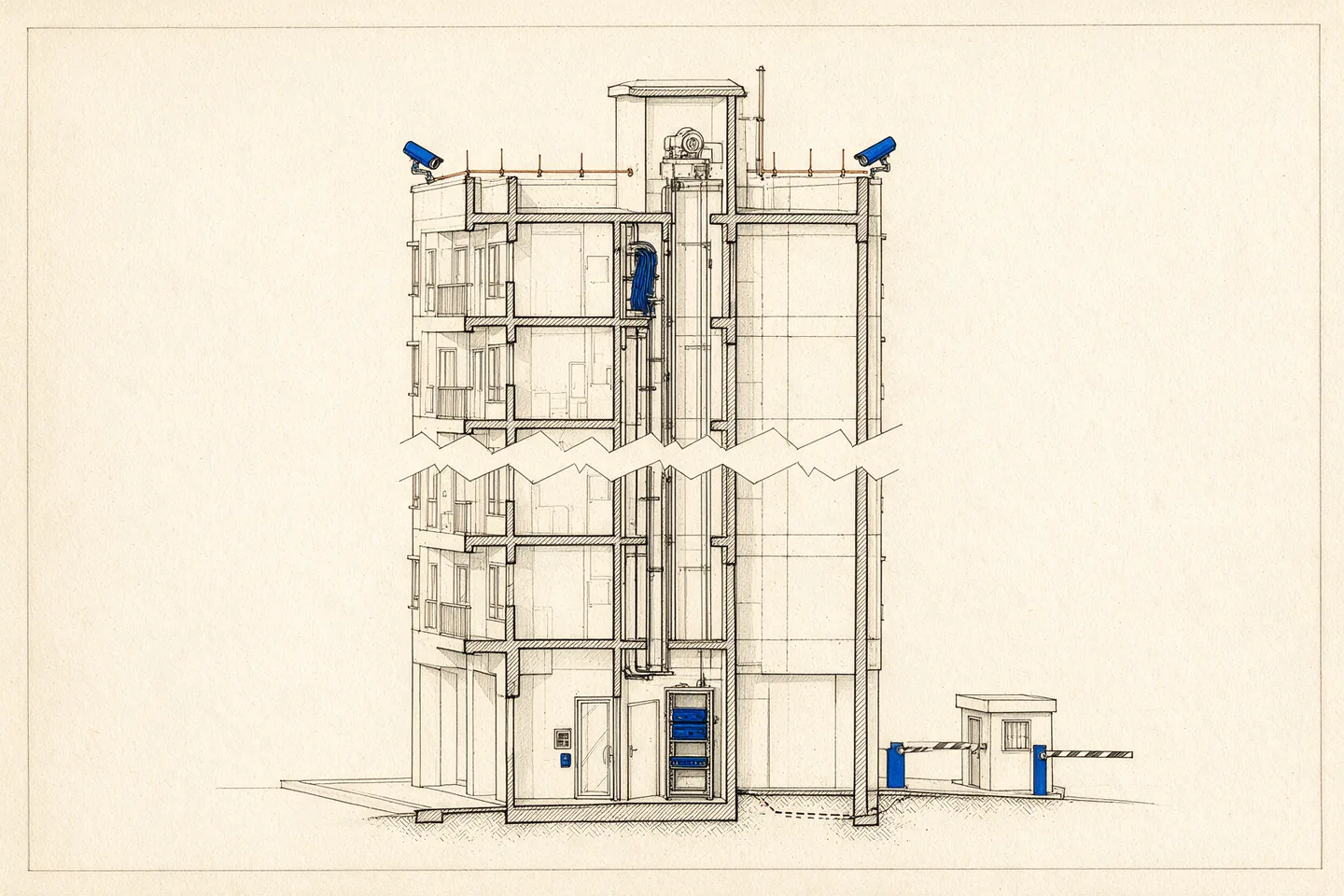
- 01Surge damage stays dead in dry weather; a water fault often comes backTHE TEST
- 02Axis lists lift motors and air-conditioning among more frequent surge causesTHE HIGH-RISE CASE
- 03The building’s damage policy names lightning; its electrical clause can decide the equipmentTHE MONEY
- 04Maintenance contracts commonly exclude storm and lightning damageTHE CONTRACT
- 05Surge protection follows the lightning risk assessment, not a shopping listTHE PREVENTION
ON THIS SHEET05 SECTIONS
Was it lightning, or something else?
Not always. Lightning is one cause of the power surges that kill a condominium’s cameras, intercoms and readers, but not the only one. Axis Communications, a camera maker, calls lightning the most familiar cause and lists among more frequent causes the switching of high-powered machinery on and off, “such as elevator motors or air conditioners”. A high-rise has both.
Nor does a surge need a direct hit on the building. A strike nearby induces a voltage on every long metal run outdoors, and a tower has plenty: rooftop and perimeter cameras, the guardhouse link, the backbone in the riser. What died tells you more than the weather did:
| What you see | Points to |
|---|---|
| A channel that comes back once the connector dries | A water fault |
| One camera at a time, getting worse over seasons | A water fault |
| Several channels dead at once since one storm | Surge damage |
| A camera and its port on the recorder both dead | Surge damage along that cable |
| Odd faults weeks after the storm | Parts that took a hit and kept working, for a while |
The table follows ClickBina’s CCTV surge guide, which also reports that after a Klang Valley thunderstorm the recorder, or a group of its ports, fails far more often than a camera. The same logic runs through a condominium’s intercom and access control: every long run ends at a controller or switch. The wider picture is in When a Building’s Security System Starts Failing.
What should the management do the morning after a storm?
The morning after a storm, the management has three jobs, in this order: find out what is down across the cameras, intercoms, card readers and barrier; keep the evidence, meaning the damaged parts, photographs and the date; then notify the building’s insurer with what was found.
- Check every channel, not just the app. A recorder can show live pictures and still have stopped writing, so play back an hour from during the storm; see Condominium CCTV Not Recording.
- Walk the other systems. Lobby and guardhouse intercoms, card readers, the car-park barrier and any lift readers; see intercom not working and access card not working.
- Cover the gaps. Until they are back, put a guard where cameras or the barrier are out, and tell residents.
- Write down the date and time. If a part fails oddly weeks later, that date is your best evidence.
- Keep the damaged parts and photograph them. Do not let anyone throw away a dead recorder, switch or panel before the insurer has seen it.
- Notify the insurer immediately. MSIG’s home-claims guidance, as one insurer’s example, asks for the time, date, extent and cause of the damage.
- Get the contractor’s findings in writing: which parts failed, on which runs, and what they found at each end of the cable.
Does the building’s insurance pay for lightning damage?
For the building, yes; for the security equipment, it depends on the wording. Section 93 of the Strata Management Act 2013 requires the JMB or MC to insure the building under a damage policy with a licensed insurer, and the Act’s definition of that policy names lightning, alongside fire, explosion and windstorms. Whether surge-damaged cameras, intercoms and readers are paid turns on the policy’s electrical installations clause.
The policy provides for repair where the building is damaged but not destroyed, and section 100 requires insurer payments to be applied immediately to the repair. One Malaysian fire policy wording, Zurich’s, carries two versions:
- Clause (A), headed for manufacturing risks and workshops, frees the insurer from damage to any electrical machine or apparatus caused by over-running, short-circuiting, arcing or leakage of electricity “from whatever cause (lightning included)”.
- Clause (B) says there is no liability for damage to any electrical machine, apparatus, fixture or fitting “unless caused by fire or lightning”.
That is one insurer’s example, not the building’s own policy. Before the AGM, ask the broker which wording it carries and whether the security equipment is within the sum insured. Section 98 also lets the JMB or MC insure other risks the owners direct by special resolution.
Nor will the maintenance contract fill the gap: storm and lightning damage is a common exclusion, Occhio Tec’s own maintenance FAQ included; see What a Security Maintenance Contract Must Cover.
How does a building stop it happening every storm season?
A condominium cannot stop the storms, but it can follow its lightning risk assessment: a lightning protection system on the roof first, then surge protective devices (SPDs), earthing and cable routing for the security systems where the assessment calls for them. The Energy Commission (Suruhanjaya Tenaga) treats the SPD assessment as a further stage after the one for the roof protection.
Storms will keep coming: MetMalaysia data show its KLIA station recorded more than 300 days with lightning every year from 2015 to 2024, the highest of 14 stations; Subang led in 2025 with 294.
The Energy Commission applied the Malaysian lightning protection standard, MS IEC 62305, by a circular in force from 1 September 2011, and enforces it through Arahan/ST/No.4/2019 for the building categories that directive lists. On SPDs, its answer is plain:
The requirement to install an SPD depends on the Risk Assessment carried out.
Ask the building’s electrical contractor whether both assessments exist, and whether the system has had a post-strike check. On the ELV side, ask about:
- Where an outdoor camera’s cable enters the building: Axis places a surge protector there, and another beside a camera further away.
- Shielded cable with a continuous earth: the shield only diverts a surge if it has an unbroken path to ground through the PoE switch; a desktop switch may need earthing separately.
- Data kept apart from power: Axis advises against running network cable parallel to power lines, so the riser layout matters; see ELV, TEL and electrical risers.
- Fibre to the guardhouse: a fibre link carries no current, so it breaks the electrical path between two structures.
Repair the damage or replace the system?
Repair like for like if the condominium’s head end is sound; if it is ageing, use the claim and the outage to replace it, weighing that with Repair or Replace an Ageing Security System. The failed parts must be put right whether or not a claim pays: under section 59(1)(a), an MC must keep the common property “in a state of good and serviceable repair”.
Occhio Tec, established 2012, designs, installs and maintains CCTV, access control and video intercom systems, mainly in mid-high to high-end condominiums in Mont Kiara, Bangsar and KLCC, including systems another contractor installed. To have the damage and the exposed runs looked at, request a site survey.
Questions committees ask about lightning damage
Q-01Does a security maintenance contract cover lightning damage?
Usually not. Storm and lightning damage is a common exclusion, and Occhio Tec’s own maintenance FAQ lists it. The route is the building’s section 93 damage policy, which the Strata Management Act 2013 requires to cover lightning, subject to its electrical installations clause.
Q-02Is surge protection compulsory for a condominium in Malaysia?
It depends on the building’s own risk assessment, not on a blanket rule, the Energy Commission says. Ask the electrical contractor whether the condominium falls within the categories Arahan/ST/No.4/2019 lists; other buildings are subject to further directives ST issues in writing.
Q-03When is lightning most frequent in the Klang Valley?
Nationally, MetMalaysia says thunderstorms occur all year, typically more frequent in April and May, and October and November. Locally, Subang recorded 294 lightning days in 2025, and KLIA more than 300 a year from 2015 to 2024. Storms develop within one to two hours.