
Condominium Barrier Gate Hit a Car: Who Pays, What Failed.
QUESTION ANSWEREDThe car park barrier came down on a resident's car. Why did it happen, what do we do today, is the JMB or MC liable, and which insurance pays?
The joint management body (JMB) or management corporation (MC) can be liable if it did not maintain the barrier; in one JMB’s claim, a third-party vehicle was paid under public liability cover. A safety loop or light beam should stop the arm closing on a car. When it does not, take the barrier out of service, keep the lane footage and maintenance records, and admit nothing.
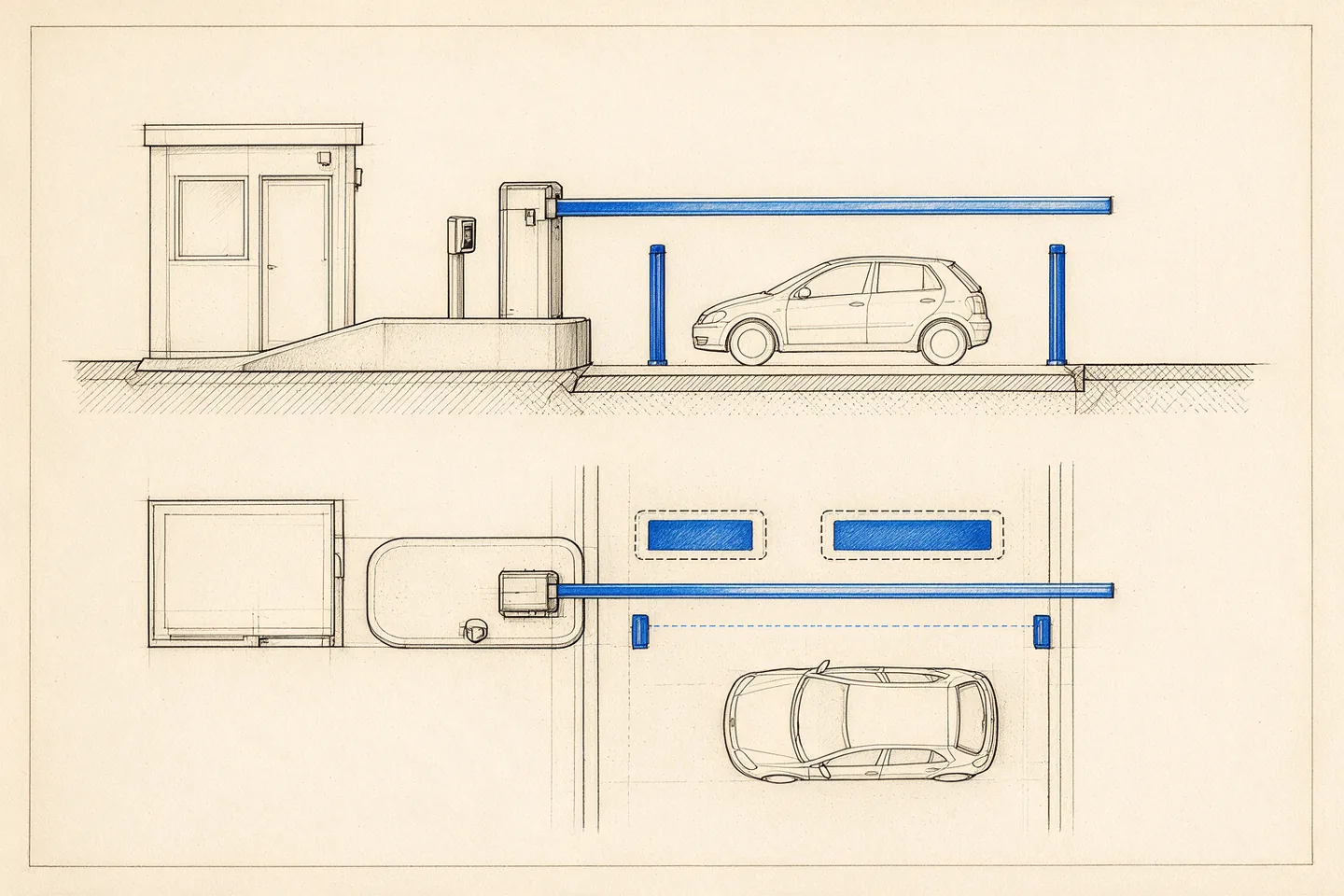
- 01The safety device must stop the arm closing on anything standing under itTHE RULE
- 02A safety loop that does not respond is a listed fault, not bad luckTHE CAUSE
- 03Courts weigh who controlled the thing that did the damageTHE LIABILITY
- 04One JMB’s claim: a third-party vehicle under public liability, the barrier under the fire policyTHE MONEY
- 05The maintenance record is the management’s best evidenceTHE DEFENCE
ON THIS SHEET06 SECTIONS
Why does a barrier come down on a car?
Because a safety device failed, or the vehicle was one it cannot see. A barrier has three jobs, our guide to condominium car park entry explains: clear the queue, refuse to close on a car, and open on an emergency signal. Closing on a car is the second job failing; the other faults are in When a Building’s Security System Starts Failing.
Magnetic Autocontrol’s operating instructions for its MicroDrive barrier are blunt: “The surveillance device must prevent the closing of the barrier in case a person or a vehicle is standing below the barrier.” That device is a safety loop cut into the deck, a light beam across the lane, or both. The safety loop must cover the danger area under the whole length of the arm, and the opening loop sits no more than 1.0 m in front of it.
| What happened | Points to |
|---|---|
| The arm came down on the car while it was still under it | A safety loop or light beam not responding, or not covering the whole arm |
| The arm stays open long after each car, then drops late | One listed cause: a safety loop that does not respond |
| The arm will not close with no car in the lane | A loop reporting a vehicle that is not there |
| The arm moves on its own, for example after a lightning strike | A defective control unit |
After a storm, see lightning damage to security systems.
What should the management do the same day?
Make the lane safe, keep the evidence and admit nothing. Take the barrier out of service: Magnetic’s manual says to deactivate a barrier with damaged components, and to replace damaged arm edge protection at once or stop using it. Put a guard on the lane, then:
- Save the lane footage now. Export the clip before the recorder overwrites it, and check the camera was recording at all; see Condominium CCTV Not Recording.
- Pull the maintenance records. The last service report, the last safety-device test and any open fault on this barrier.
- Take the resident’s details and photographs, and promise only to investigate. One insurance agency’s lesson: “It is important NOT to admit mistakes or offer settlements upfront if approached for compensation.”
- Notify the insurer and get the contractor’s written finding: which device failed, and why.
Is the JMB or MC liable for the damage?
It can be, and the questions that matter are whether the barrier was maintained and who controlled it. Under the Strata Management Act 2013, section 21(1)(a) makes it the JMB’s duty, and section 59(1)(a) the MC’s, to keep the common property “in a state of good and serviceable repair”. Section 2’s definition of common property includes “so much of a subdivided lot used or enjoyed by the occupiers of two or more parcels”.
Two condominium rulings show how courts reason:
- A burst common pipe: in ACN Infra Sdn Bhd v Perbadanan Pengurusan Kondominium Subang Indera [2020] 3 AMR 741, the High Court found an MC negligent and awarded RM348,930. The pipe was under the MC’s sole control, so the MC had to prove it was not negligent; the court held the failure should have been anticipated even without periodic inspections.
- A break-in: the Shah Alam High Court held the Act does not oblige an MC to establish or maintain a security system, and refused that burden-shifting because the break-in did not occur within the management’s control.
A barrier arm is equipment the management operates, which puts a barrier claim closer to the pipe than to the break-in, though neither ruling decides any particular incident. A breach of statutory duty alone cannot found a private claim; the resident must show negligence.
Which insurance pays for the car and the barrier?
In one JMB’s claim published by the Malaysian insurance agency eDindings, two sections paid after a barrier malfunction: public liability for the damaged third-party vehicle, and the fire policy for the barrier. Public liability is the section of a JMB package that answers for third-party property damage from accidents in common areas.
- The fire policy paid the barrier repair, and the cabling works to adjust and balance it, as impact damage.
- A new concrete island and a radar vehicle detector were refused as enhancements or improvements.
That is one building’s outcome, not your policy: the cause of the incident decides which section responds. Check that public liability names the JMB alone. In another eDindings claim, a resident’s car hit by a malfunctioning barrier was first rejected because all residents and the JMB were named as insured; it was paid only on appeal. eDindings also records a lift injury claim rejected because the maintenance records showed no defects and the footage supported no negligence. A resident on a Malaysian forum gave the fallback: claim on your own motor insurance and lose the no-claim discount.
What should the maintenance records show?
That the barrier was maintained to its manufacturer’s schedule; check your own barrier’s manual for its figures. Magnetic’s manual tells the operator to test the barrier system monthly and to observe maintenance intervals set monthly, six-monthly and yearly, shortened where wear shows:
- Every year, check any light barriers, and measure each loop’s contact resistance, insulation resistance and inductivity.
- A sound loop reads above 1 megohm insulation resistance; outside the manual’s values, the loop is replaced.
- Who does what must be written down: installation, operation, maintenance and cleaning.
Check the barrier lines in the building’s agreement against that list; What a Security Maintenance Contract Must Cover explains the rest. A service report that records a visit but no test result gives the management little to show in a dispute.
Repair the barrier, or rethink the lane?
Repair first, then decide whether the lane needs more. The insurer pays to restore, not to improve, and Magnetic’s manual requires the manufacturer’s written authorisation for any change to its barrier, so a second safety device or a separate path for people is an upgrade the committee funds on its merits.
Occhio Tec, established 2012, designs, installs and maintains access control, including boom barriers and car park systems, alongside CCTV, mainly in mid-high to high-end condominiums in Mont Kiara, Bangsar and KLCC, including systems another contractor installed. Building managers’ letters on our work page name barrier gate operations among them. To have the barrier and its safety devices tested, request a site survey.
Questions committees ask about barrier damage
Q-01Can a resident take the JMB or MC to the Strata Management Tribunal over barrier damage?
The Tribunal hears complaints that the management failed to perform a duty under the Strata Management Act 2013, and can order compensation for loss or damage. It hears claims of up to RM250,000, and the Limitation Act 1953 does not apply to its proceedings.
Q-02Does a park-at-your-own-risk sign protect the management?
Do not rely on it. In the Sunway Parking case the Court of Appeal upheld a ruling that a paid car park operator, holding the car as bailee, could not rely on its own-risk clause after a thief tailgated out through a slow barrier; damages were about RM117,000. That was a commercial car park, not a condominium.
Q-03Why does a barrier sometimes fail to detect a vehicle or a person?
Induction loops respond only to metal, and only to enough of it over the loop. They are set not to respond to people or bicycles, and a vehicle with too little metal in its floor needs a complementary device, such as a light beam. The barrier is not approved for pedestrians, bicycles or animals.