
Condominium Access Card Not Working: How to Find Out Why.
QUESTION ANSWEREDResidents' access cards keep being refused at the doors or lifts: what should be checked first, and where does the fault usually sit?
When a Malaysian condominium’s access cards are not working, check the building’s own records before calling a contractor: a card may have been deactivated for arrears, expired, or never reached that door’s controller. If not, read the pattern (one resident’s cards, one door, certain hours, every door, or in a power cut); each points to a different part of the access control system.
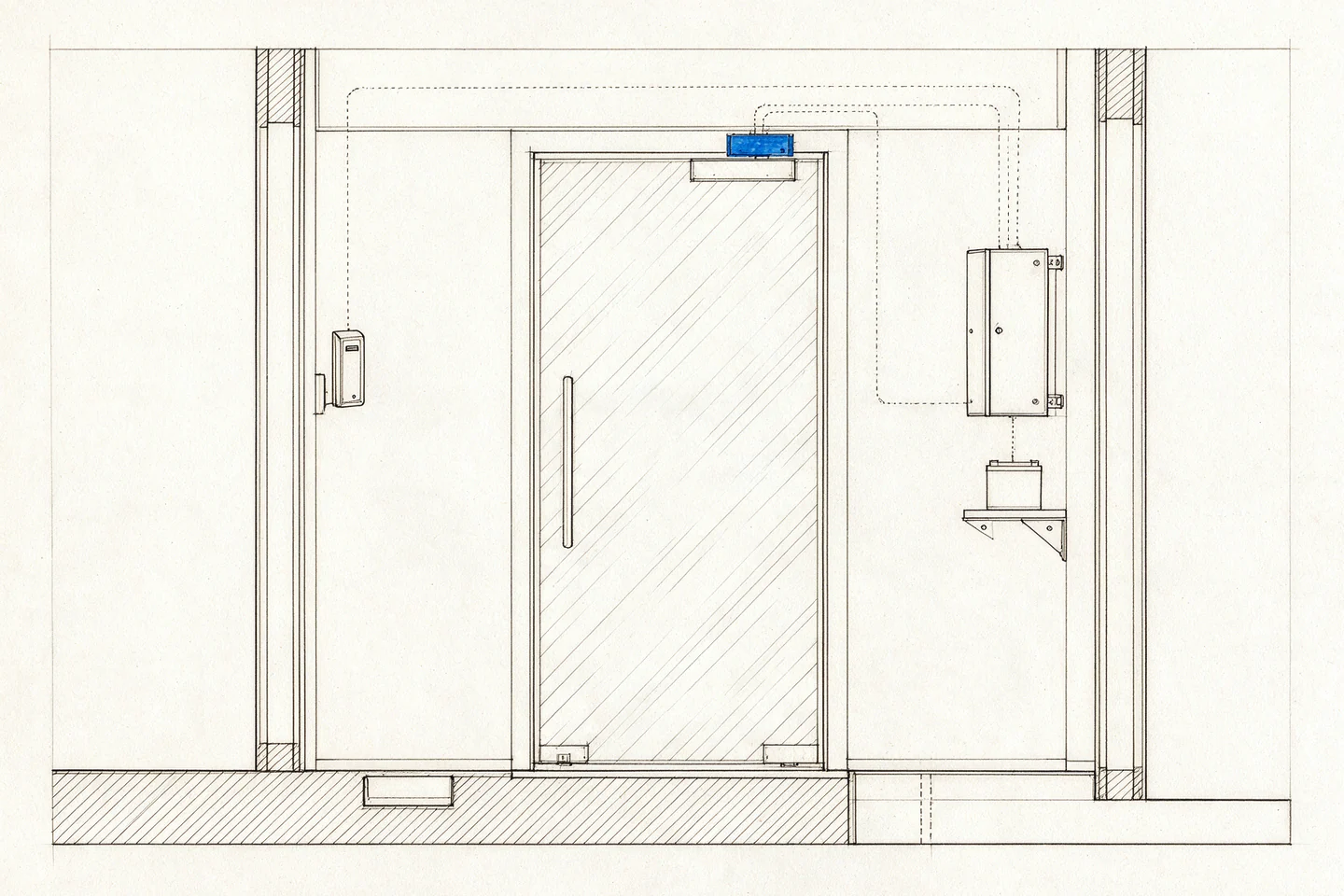
- 01Strata Management Regulations 2015: a defaulter’s card may be deactivated only after a 14-day notice periodRECORDS
- 02HID: a reader-controlled LED turns green when the card is read and passed onREAD
- 03MicroEngine: a transaction report can be pulled by date and card numberASK
- 04Exit-door release: verify the applicable rules and approved emergency-release design before changing backup powerEXIT DOORS
- 05Yuasa: NP series standby batteries have an expected life of 3 to 5 years in float servicePOWER
ON THIS SHEET06 SECTIONS
What should the management office check before calling a contractor?
Before calling a contractor about refused access cards, the management office should rule out three causes in its own records: a card deactivated for arrears, a card past its expiry date, and a card that never reached a door’s controller.
Under the Third Schedule to Malaysia’s Strata Management (Maintenance and Management) Regulations 2015, an owner is a defaulter if a sum is unpaid “at the expiry of the period of fourteen days of receiving a notice” (by-law 6(1)(a)), and by-law 6(4) lets management “deactivate any electromagnetic access device such as a card, tag or transponder, issued to a defaulter”. The by-laws bind a Joint Management Body (JMB) as well as a Management Corporation (MC), under by-law 2(1)(a).
In Mok Siou Min v Hampshire Residences Management Corporation [2018] 1 LNS 333, a BurgieLaw case note reports, deactivation was held unlawful because no notice was produced.
Then the card records. In MicroEngine’s xPortal3000 software each card carries a start date and an expiry date, and a new card that works at some doors only may not have reached every controller: the manual says to check the delivery report for errors. For the wider picture, see When a Building’s Security System Starts Failing.
What does the pattern of refused access cards point to?
The pattern of refused access cards shows where to look first: one resident’s cards failing everywhere points to that card’s record, every card at one door to that reader, its cable or its controller, certain hours to a schedule or a clock, every door at once to shared control or power, and a card that opens the lobby but not the lift to floor permissions. A magnetic lock releasing in a power cut is not by itself proof of a faulty battery: first establish the door’s exit function and intended backup-power design.
| Pattern | Look first at | Ask the management office for |
|---|---|---|
| One resident’s cards, every door | The card’s record | Its status and expiry date |
| Every card, one door | That reader, its cable or controller | That door’s transaction report |
| Reader beeps, door stays shut | A refusal first, then the lock | The transaction report; a lock voltage check |
| Refused at certain hours only | The access schedule or the clock | The card’s time zone; the controller’s time |
| Lobby door opens, lift will not | The card’s floor permissions | The card’s floor zone |
| Every door at once | The controller (the head end) or its power | Controller status; any power interruption |
| A door expected to have backup power unlocks in a power cut | The power supply, battery and approved release design | Whether the door is an exit; backup-power test results |
Why does the card open the lobby but not the lift?
If a card opens the lobby door but not the lift, ask management to check the card’s floor permissions. MicroEngine’s xPortal3000 manual distinguishes floor zones from door access: a working lobby reader does not establish permission for every lift floor.
Why does the card reader beep when the door will not open?
A card reader can beep while the door stays shut because reading a card and opening the door are separate jobs: the reader passes the card on, and the controller decides, records the attempt and drives the lock. HID’s reader guide says a reader-controlled LED “turns green when the access card is read and the message is transmitted to the Host system.”
On one MicroEngine controller family a valid card gives 1 beep and an invalid card 3 beeps, so on that system one beep and a shut door points to the lock or its power.
The controller’s record explains a refusal. MicroEngine’s manual says the date and time affect “event transactions logging” and the time zones that decide when a card may pass, so a wrong clock applies the schedule at the wrong hours, as it mistimes a CCTV recorder (see CCTV not recording: how to find out why). Its xPortal3000 software produces a transaction report by date, time and card number: ask for it before any part is replaced.
What does it mean when doors unlock in a power cut, or will not stay locked?
A magnetic lock releases when power to the lock is removed. That alone does not diagnose a battery fault: an exit door may need to release, while a door designed to remain powered through an outage needs its supply and backup checked. If a powered magnetic lock will not hold, a technician should check voltage, strike mounting and contact surfaces, as Securitron’s Magnalock instructions describe.
The cited 1984 text of by-law 173(2) specifies exit-door release on power failure or fire-alarm actuation. Before changing a lock or its backup supply, have the building’s competent professional confirm the applicable gazetted rules and approved fire-escape design. A general troubleshooting guide cannot determine those requirements for an individual building.
Where the approved system design includes standby power, a battery can keep the lock powered during an outage; it must not defeat a required emergency release. Batteries wear out. Yuasa gives its NP series batteries “an expected life span of 3 to 5 years in float service applications”, designs them for about 5 years at about 20°C, and says “high ambient operating temperatures” speed the wear: expect less from a battery in a warm riser.
What should the contractor’s report say after an access card fault?
The contractor’s report on an access card fault should record the doors and cards affected, what the transaction report shows, the clock error, lock and power readings, the battery’s age and whether exit doors met the applicable emergency-release design on test, because the committee may have to explain a refused resident or a released door to owners.
- N01Doors and cards affected, with a controller transaction-report extractATTACHED
- N02What the controller transaction report shows for each refused cardSTATED
- N03Controller clock error against a referenceMEASURED
- N04Voltage and holding at each lockRECORDED
- N05Battery installation date and test resultRECORDED
- N06Exit-door power-failure and fire-alarm tests match the approved release designWITNESSED
How does a building stop access card failures coming back?
A building stops access card failures coming back by making three jobs somebody’s defined responsibility: replacing standby batteries within their rated life, testing exit-door release against the applicable rules and approved fire-escape design, and keeping the ability to pull a transaction report inside the building, not with a departed contractor.
The first two belong in what a security maintenance contract must cover; the third in what a JMB inherits at developer handover. For repeated failures, see how long a building’s CCTV, access control and intercom last.
Occhio Tec is an Extra Low Voltage contractor established in 2012. It designs, installs and maintains CCTV, access control, video intercom and structured networking, describes its niche as service and maintenance in high-end condominiums in Kuala Lumpur’s Mont Kiara, Bangsar and KLCC, holds MicroEngine’s Authorised System Installer appointment, made in 2014, and takes over systems another contractor installed. Request a site survey or send a WhatsApp message to +60 11-6494 4931.
Questions committees ask about refused access cards
Q-01What may a JMB or MC charge to reactivate a deactivated access card?
By-law 6(4) of the Third Schedule to the 2015 Regulations allows “a charge not exceeding ringgit fifty” on top of the sum owed. Meanwhile the owner may have to sign a defaulters’ register book to be let in or out; a written instalment scheme may withhold the deactivation (by-law 6(6)).
Q-02Why can a tenant’s card be deactivated when the tenant has paid?
The by-laws follow the parcel, not the payer. By-law 6(1)(b) of the Third Schedule extends a restriction against a defaulter to any “lessee, tenant or occupier of his parcel”, so a tenant can lose card access over the owner’s arrears. The management office can confirm whether that is the cause.
Q-03Why has a card stopped working completely after a few failed taps?
It may be locked out. MicroEngine’s optional Card Lock Out mode leaves a card “locked permanently after failure to gain access for three consecutive times”, from a wrong PIN, a wrong time zone or an anti-passback violation (anti-passback refuses a card used twice in the same direction). Check the card’s record, not the reader.