
Barrier Gate Systems in Malaysia: A Complete Guide.
QUESTION ANSWEREDWe are replacing or specifying a car park barrier. What types are there, how do cars get through, what safety, power, fire and maintenance rules apply, and what decides the cost?
A barrier gate, or boom gate, is a motor-driven arm that opens a vehicle lane when a card, tag, number-plate camera or guard tells it to, and must never close on anything below it. Choosing one means matching the arm to the lane and the ceiling, then settling the safety loops and what happens in a power failure or fire before anyone buys, and testing it monthly after.
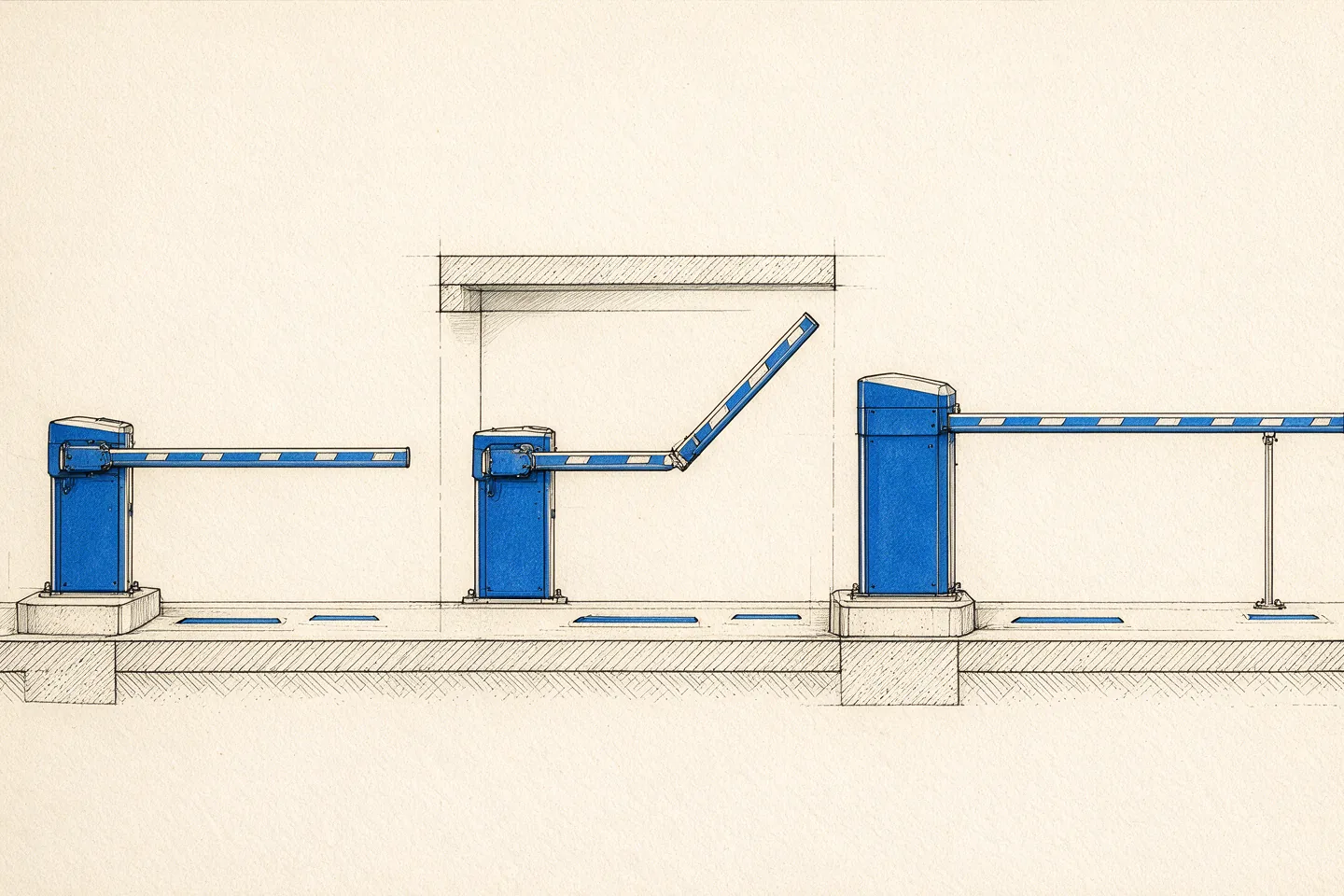
- 01The arm must never close on anything below it; for cars, safety loops reach 500 mm either side of itTHE RULE
- 02Under a low slab, a folding arm is listed for headroom from 1,800 mmTHE CHOICE
- 03Opening on power failure is an option on some models: decide it before you buyTHE SETTINGS
- 04Test monthly, and service the barrier at six and twelve monthsTHE UPKEEP
- 05Ratings of 2,500,000 to 5,000,000 cycles assume the recommended maintenanceTHE LIFE
- 01What a barrier gate is and how it works§01
- 02The types of barrier gate§02
- 03How residents and visitors get through§03
- 04The safety devices it must have§04
- 05How fast it is, and how many cars a lane takes§05
- 06Power failures and fires§06
- 07The maintenance it needs§07
- 08Why it stops working§08
- 09How long it lasts§09
- 10What decides the cost§10
- 11Who pays when it damages a car§11
- 12Boom gates in landed guarded neighbourhoods§12
- 13Planning a new or replacement barrier: a checklist§13
- QQuestions committees askF-A
ON THIS SHEET13 SECTIONS
What is a barrier gate and how does it work?
A barrier gate, also called a boom gate or boom barrier, is a housing beside a vehicle lane with a motor-driven arm that lifts for one vehicle and lowers behind it. A barrier gate system in Malaysia pairs it with a reader as the vehicle half of a building’s access control: the reader decides who may pass, and the barrier makes sure only they do.
It works alongside the CCTV over the lane and the guardhouse intercom, which is why our guide Every layer, one contractor treats it as one layer of the building’s systems. The machine itself is simple. One manufacturer’s operating instructions put it in a sentence: “The barrier consists of the barrier housing with drive system and control, as well as the barrier arm.” The arm’s weight is carried by springs, so the motor only moves a balanced arm. That is why the spring setting appears both in the yearly service and in the fault list further down this guide.
The barrier takes its orders from one of two places. A person can run it in a manual mode, which is the guard’s button, or an access control system runs it in an automatic mode, and either way it is watched over by induction loops in the road and safety light barriers across the lane. Our guide to condominium car park entry sums up its job, whatever reader sits in front of it: “clear the queue, refuse to close on a car, and open on an emergency signal”.
Better drives add a second line of defence. One fast car park model limits the motor’s torque electronically so the arm stops at once if it meets an obstacle while closing. That protects the car and the arm, but it does not replace the loops and light barriers, which stop the arm before it touches anything.
What types of barrier gate are there?
Barriers differ by what the lane asks of them: how wide it is, how much headroom it has, and how often it opens. Choose the arm first, because the lane fixes it, then the drive, because the traffic fixes that.
| Type | Where it fits | What the datasheet says | Watch for |
|---|---|---|---|
| Straight-arm car park barrier | Ground-level entrances and guardhouse lanes | One range covers lanes from 3.66 m to 6.10 m wide and opens in 1.3 to 2.2 seconds | Closing is slower than opening: 4.0 seconds on that range |
| Folding (articulated) arm | Basement entrances under a low slab | Made for car parks with reduced ceiling height; listed for headroom from 1,800 mm | Rated for 2,500,000 cycles between failures, half the maker’s straight-arm model |
| Long arm with a support | Wide gates, loading yards, commercial and industrial sites | Arms of 3 to 8 m on one industrial model; another range adds a pendulum support from a 4.57 m arm | Rated for 3,000,000 cycles with the recommended maintenance |
| Breakaway arm (SwingAway) | Lanes where arms get hit | An arm pushed out of its mounting returns by itself after a delay | Without it, a knocked-off arm is replaced |
The drive matters as much as the arm. The straight-arm range in the table is rated for a 100 per cent duty cycle, which means it may run continuously rather than resting between cycles. At an entrance that cycles from the morning rush to the last car home, ask every bidder for the duty cycle on the datasheet, not a description of it.
The long-arm row has a second lesson. Past 4.57 m, one range adds what its manual calls a pendulum support, fitted to the arm itself, and the arm’s edge protection is mounted in front of and behind it, so it belongs in the drawing before it belongs in the quotation. The folding arm solves the opposite problem: the arm bends at a hinge so it can lift under a slab that a straight arm would hit.
How do residents and visitors get through the barrier?
Through whatever sends the barrier its open signal, and most buildings use more than one method. Our guide to tag, card or number plate compares the resident methods in depth; this is the overview a committee needs before it reads the quotations.
| Method | How it works | What to check |
|---|---|---|
| Access card at a reader | The driver stops and presents the building’s card at a reader on a post | Whether the same card also runs the lobby and lift readers |
| Long-range tag or card | A UHF reader picks it up at a distance; one Malaysian integrator says typically around 3 to 6 metres | The reader must work in the 919 to 923 MHz band MCMC sets for RFID, inside its power class |
| Touch ’n Go RFID tag | A tag fixed to the windscreen or headlamp, one tag per vehicle | Whether the building can add and remove a resident’s own tag on its list, since the tag is not the building’s to cancel |
| Number plate recognition (ANPR) | A camera reads the plate and checks it against a list | Which plate types the software supports, and the camera’s mounting angles |
| Guard’s button or intercom | A person opens the barrier in manual mode, usually for visitors | What the guardhouse records about each visitor |
An ANPR barrier gate works only inside its conditions. A camera maker’s white paper lists them: many ANPR suppliers handle only retroreflective plates, the camera must stay inside the mounting angles the software supplier specifies, the minimum pixels across a plate “can differ per country”, and the camera should sit higher than the plate to reduce headlight glare. Ask for any accuracy figure under your lane’s conditions, in writing; our car park entry guide compares plates with tags.
Visitors still need a person or a process. The guard’s button is the barrier’s manual mode; what the guardhouse may write down about a visitor is in can a guardhouse keep your IC, and how a visitor app fits in is in condominium visitor management. The readers and cards themselves are covered on our access card and lift access control page.
What safety devices must a barrier gate have?
Devices that stop the arm closing on anything below it. In one manufacturer’s words: “The surveillance device must prevent the closing of the barrier in case a person or a vehicle is standing below the barrier.” Two kinds of device do that job, induction loops cut into the road and safety light barriers (photocells) across the lane, and the manual sets rules for both.
| Device or rule | What the manual requires |
|---|---|
| Safety loop | Covers the danger area under the arm along its whole length, and for passenger cars reaches at least 500 mm in front of and behind the arm |
| Opening loop | Sits in front of the safety loop, no more than 1.0 m from it |
| Safety light barrier | Commissioning test: an object held in the beam makes the receiver’s yellow LED go out |
| Clearance | At least 610 mm between the arm and walls or other objects |
| Edge protection on the arm | Replaced immediately if damaged, or the barrier taken out of operation |
| A separate way for people | Pedestrians get their own access opening |
Loops have a blind spot. They respond only to metal, and what counts is how much of the loop the metal covers, not how heavy the vehicle is. For vehicles with too little metal in their floor for the loops to detect, the manual requires “other or complementary safety facilities”, such as a light barrier as well as the loop. Ask the supplier which vehicles its loops will not see at your entrance.
People are the other blind spot. The manual is blunt: “Pedestrians must be supplied with a separate access opening”, and “The barriers are not approved for pedestrian traffic, bicycles or animals.” A lane where residents walk under the arm to reach the lobby needs a pedestrian gate beside it, not a more sensitive barrier. What follows when one of these devices fails is in our guide to a barrier arm hitting a car.
How fast is a barrier gate, and how many cars can one lane take?
Quick to open and slower to close. On one manufacturer’s range the arm opens in 2.2 seconds on the base model and 1.3 seconds on the faster ones, and closes in 4.0 seconds on all of them, so on the fastest models closing takes about three times as long as opening. Closing is the half of the cycle a committee should ask about.
A fast car park barrier from another maker is adjustable from 1.2 to 3 seconds, which its datasheet says allows 1,500 vehicles an hour. That is the barrier’s limit, not the lane’s. A lane where every driver stops, lowers the window and presents a card moves at the driver’s pace, which is one reason busy entrances look at long-range tags or plate cameras instead.
Speed is also security. In the Sunway Parking case, a paid commercial car park rather than a condominium, a thief escaped behind another car “as the barrier gate was too slow in coming down to prevent the stolen vehicle from escaping”, and the damages ordered came to about RM117,000. A slow arm lets a second car follow the first; the closing time belongs in the specification, not in the small print.
What happens to a barrier gate in a power failure or a fire?
Whatever it has been set to do, so decide it before you buy. One range has a “Power failure” menu in which “you can set the barrier behaviour in case of voltage failure”; another maker lists automatic opening in case of power failure as an option, not a standard feature. A building that wants its lanes to open when the power goes has to ask for it, and pay for it.
In a power failure the arm may stop at its upper or lower dead point, depending on the spring and menu settings, where it “can no longer be easily moved manually”. Someone then has to open the housing and free the arm with a tool, following the manufacturer’s steps. Keep those steps, the tool and the housing key at the guardhouse, and make sure each guard shift knows where they are.
A fire is different: the barrier must open and stay open. The manufacturer’s wiring instructions connect fire-fighter switches and emergency opening contacts to a high-priority open input: “When the signal is applied to this input, the barrier opens. While the signal is present, the barrier cannot be closed”. The building side of the same duty is the Uniform Building By-Laws 1984, by-law 140: every building over 7,000 cubic metres must abut a road or open space at least 12 metres wide and accessible to fire brigade appliances, so plan the barrier so it never blocks the appliance.
What maintenance does a barrier gate need?
A monthly test, with more work every six and twelve months. One manufacturer’s safety instructions are five words long: “Test the barrier system monthly.” Behind that test sits a schedule of monthly, six-monthly and twelve-monthly work, and the intervals are to be shortened wherever an inspection shows increased wear.
| Interval | Work |
|---|---|
| Monthly | Test the barrier system. Inspect the arm for damage and corrosion, the foundation anchors and mounting for corrosion, and the lenses and mirrors of the light barriers |
| Every 6 months | All the monthly work, plus a check of the earth-leakage protection (GFCI) and of the arm and flange screws for a tight fit |
| Every 12 months | All of the above, plus the spring setting of the lever system, a measurement of each loop’s contact resistance, insulation resistance and inductivity, and a check of the light barriers and other safety equipment |
Who does the work must be written down. The same manual tells the operator to “clearly determine the responsibilities for installation, operation, maintenance and cleaning of the barrier.” In a condominium the operator is in practice the JMB or MC, whose duty under the Strata Management Act 2013 is to keep the common property “in a state of good and serviceable repair”.
A maintenance agreement that names the barrier and copies the maker’s schedule turns that duty into a record: dated visits, loop readings, the light-barrier test. What such an agreement must oblige, and what it usually leaves out, is in a security system maintenance contract. Paying for the routine visits and paying for a replacement come from different funds, which is the subject of sinking fund or maintenance fee.
Why does a barrier gate stop working?
Most of the causes in one manufacturer’s fault table are detection or adjustment faults, such as loops, sensitivity settings and spring tension, rather than a dead motor, though a defective control unit is listed too. The table below is an abridged selection from it, and several of its causes are items the maintenance schedule already checks.
| What you see | A listed cause | First step |
|---|---|---|
| The arm stays up | The loop reports a vehicle although none is there | Measure the loop: a sound loop reads above 1 megohm insulation to earth; replace it if its readings fall outside the maker’s ranges |
| The arm closes late, only after the hold-open time | The safety loop does not respond | Check the safety loop’s response sensitivity and adjust it |
| The arm does not open fully | Balancing springs set too weak for the arm’s weight | Spring adjustment by the service specialist |
| The arm was knocked out by a car | The arm has left its mounting | A breakaway arm returns after a delay; any other arm is replaced |
| The arm moves by itself | A defective control unit | Take the barrier out of service |
| Faults after a storm | A lightning strike | Have an electrician check the barrier for damage and proper function |
The second row is the one to rule out first: the safety loop is the device meant to keep the arm off a car. If the arm has already come down on a vehicle, the first steps and who pays are in what to do when a barrier damages a car.
Not every lane fault is the barrier’s. If the arm works but residents’ cards are refused, the fault is in the reader, the card or the database, which is where an access card not working starts. Storm damage often reaches several systems at once; lightning damage to security systems covers what to check across the building. Faults across the whole building are gathered in When a building’s security system starts failing.
How long does a barrier gate last?
Manufacturers rate barriers in cycles, not years. A fast straight-arm car park barrier is rated for 5,000,000 mean cycles between failures, “when respecting recommended maintenance”; the same maker’s folding-arm model for low ceilings is rated for 2,500,000, and an industrial long-arm barrier for 3,000,000 cycles with the recommended maintenance. Every cycle rating in this guide is given on that condition.
To turn cycles into years, count your own lane. As an illustration, not a measurement, a lane that opens 1,000 times a day reaches 2,500,000 cycles in 2,500 days, just under seven years. Mean cycles between failures is an average gap between breakdowns, not an end date.
When an older barrier keeps failing, the decision is the one in repair or replace an ageing system, and how the barrier ages beside the CCTV and intercom is in how long a building’s security systems last. The manual’s own advice points the same way: where inspections show increased wear, shorten the maintenance intervals rather than wait for the next fault.
What decides what a barrier gate costs?
The work around the barrier as much as the barrier itself: one maker’s datasheet lists ground fastening and the power supply as work the customer provides. We do not publish prices, because two quotations for “a barrier gate” can describe different jobs. These are the items that move the total, and each should appear as its own line:
- The arm. Lane width sets its length; one range adds a pendulum support from a 4.57 m arm, and a low basement slab calls for a folding arm.
- The civil and electrical work. The foundation and power supply, and the loops cut into the road surface.
- The safety devices. Loops sized to the arm, a light barrier where loops cannot see every vehicle, and a pedestrian gate beside the lane.
- The access method. A plate camera comes with mounting and pixel conditions; a long-range reader with radio rules; a card reader with the card system it must join.
- The settings. Opening on power failure is an option on some models, and the fire-fighter input has to be wired to the building’s fire system.
- The maintenance. The cycle ratings in this guide assume the recommended maintenance, so price the visits for the life of the barrier.
One JMB’s insurance claim shows why the scope should be right at the start. After a barrier malfunction, the barrier repair and cabling were paid as impact damage under the fire policy, but a new concrete island and a radar vehicle detector were refused as enhancements or improvements. Insurance restores; it does not upgrade. Later changes also cost more than they look, because technical changes and extensions need the manufacturer’s written authorisation.
Comparing bids that list different equipment is its own skill, set out in comparing security system quotations. A barrier that has to work with the card system, the CCTV over the lane and the guardhouse intercom is also where split contractors cause trouble, as one contractor or five explains.
Who pays when a barrier gate damages a car?
Start with the management’s duty of repair. Under the Strata Management Act 2013 a JMB, and in the same words an MC, must keep the common property “in a state of good and serviceable repair”, so a poorly maintained barrier leaves the management exposed. In one JMB’s claim after a barrier malfunction, the third-party vehicle was paid under the public liability cover and the barrier repair under the fire policy.
The maintenance record matters because it shows whether the safety devices were tested and working. The Sunway Parking judgment above involved a barrier that closed too slowly. The court reasoning, the insurance sections and the steps to take on the day are set out in full in a condominium barrier gate hit a car, so they are not repeated here.
What rules apply to boom gates in landed guarded neighbourhoods?
Planning and council rules rather than strata law, because a guarded neighbourhood sits on public roads: a guarded community “does not automatically turn a public residential road into a private one”. Malay Mail set out the rules for the Klang Valley on 28 September 2026:
- PLANMalaysia: at least 85 per cent of residents must agree before an application can be made.
- Selangor: 75 per cent consent for a manual boom gate, and 100 per cent for an automatic boom gate or access-card system.
- DBKL: at least 81 per cent consent for a guarded neighbourhood scheme, and 100 per cent for automatic boom gates using facial recognition.
- Hours: a boom gate is generally allowed to operate from midnight to 6am under the PLANMalaysia guideline.
- Emergencies: at least two entry and exit routes for emergency purposes; in Petaling Jaya, MBPJ requires guards to be briefed on agencies including the police, the Fire and Rescue Department and ambulance services.
For a landed residents’ association, the choice between a manual and an automatic barrier is therefore a consent question before it is a technical one. Councils can add their own conditions, so check the current ones with yours before ordering anything. Inside a strata development, the strata by-laws and the JMB or MC decide instead.
How should a building plan a new or replacement barrier gate?
Settle ten decisions before asking for quotations, each written as a line in the scope of works so every bidder prices the same lane: the lane and headroom, the traffic, the loops, a way for people, the clearance, the power-failure setting, the fire route, the access methods, the radio rules and an owner for each task.
- Measure the lane and the headroom. Width sets the arm; a low slab needs a folding arm, which one maker lists for headroom from 1,800 mm.
- Count the traffic. Choose the drive by its duty cycle and its closing time, not its opening time.
- Draw the loops. A safety loop under the whole arm, 500 mm beyond it on each side for cars, and an opening loop within 1.0 m.
- Give people their own way. A pedestrian opening beside the lane, never under the arm.
- Keep the clearance. At least 610 mm between the arm and any wall or column.
- Decide the power-failure behaviour. Open, closed or held, and whether automatic opening is an extra.
- Wire the fire route. The fire-fighter switch to the high-priority open input, and the appliance route kept clear.
- Choose the access methods. Get any plate-recognition figure stated for your lane’s conditions, in writing.
- Check the radio rules. A long-range reader below 2 W ERP falls under MCMC’s class assignment; above 4 W is not permitted.
- Name the owner of each task. Installation, operation, maintenance and cleaning, with the maker’s schedule in the maintenance agreement.
Occhio Tec, established 2012, supplies, installs and maintains barrier gates under its Pedestrian Entry & Vehicle Access service, which covers “Turnstiles, gates, boom barriers and car park systems”. Letters from building managers on our work page name barrier gate operations among the systems, and we also take over systems another contractor installed. The barrier service itself is described on barrier gates and car park entry. A lane is a site question: request a site survey.
Questions committees ask about barrier gates
Q-01Can motorcycles use a car park barrier lane?
The manufacturer’s manual does not name motorcycles, so ask the supplier before you allow them. Induction loops respond only to metal, by how much of the loop the metal covers, and the manual requires other safety devices for vehicles with too little floor metal for the loops to detect. Its barriers are not approved for bicycles or pedestrians.
Q-02Do we need MCMC approval for a long-range tag reader?
It depends on the reader’s power. Under MCMC’s SRSP-530, an RFID reader below 2 W ERP is authorised by class assignment, which needs no application and no fees. Up to 4 W needs an apparatus assignment, and above 4 W is not permitted. Ask the supplier to show that the reader works in the 919 to 923 MHz band and carries SIRIM approval, as one Malaysian integrator states for its readers.
Q-03Can one card open the car park barrier and the lift?
Yes, if the readers are planned together. One Malaysian integrator recommends a combined card for condominiums, carrying both a long-range UHF chip and a Mifare or proximity chip, so one card works the car park, main entrance and lift readers.
Q-04Can the management stop an owner in arrears at the barrier?
The 2015 strata by-laws allow it, after the notice period. By-law 6(4) lets the management deactivate a card, tag or transponder issued to a defaulter and caps the reactivation charge at RM50. By-law 6(5) extends the suspension to a car park bay designated for the defaulter’s use.
Q-05What should we do with the barrier when a storm is forecast?
Follow the manufacturer’s wind limit. One manual warns that above 10 Beaufort the arm may break off from the wind load and cause severe injuries, and says to remove or secure the arm and stop operating the barrier during storm warnings above that strength.
Q-06How do we check that the safety light barrier is working?
Use the commissioning test in the manufacturer’s instructions: hold an object in the beam, and the receiver’s yellow LED must go out. Inspect the light barrier’s lenses and mirrors monthly, and check its function, with the barrier’s other safety equipment, at the twelve-monthly service.
Q-07Can our own technician add a sensor or change the barrier?
Not without the maker’s written approval. One manual says technical changes and extensions to the barrier need the manufacturer’s written authorisation, so a sensor added without it is a change the maker never approved. Ask the supplier to obtain that authorisation first, and keep it with the maintenance record.